Period Calculator Online is one of those tools that every woman wishes she had discovered earlier. Let me be honest with you. I have seen so many women in my life get stressed just because their period came two days late. They start overthinking, they start Googling symptoms, and they start panicking for no reason. Most of the time, the reason is very simple. They were just not tracking their cycle with a period calculator online.
If you are one of those women who always forgets when her last period started, or you are never sure when the next one will come, then this free Period Calculator is made exactly for you.
In this guide, I will explain in very simple words how to use a period calculator, how it actually works, what is a normal cycle, what is not normal, and when you should really worry and when you should not. This is not a doctor’s boring lecture. This is a real, human guide written for real women in the USA in 2026 and 2027.
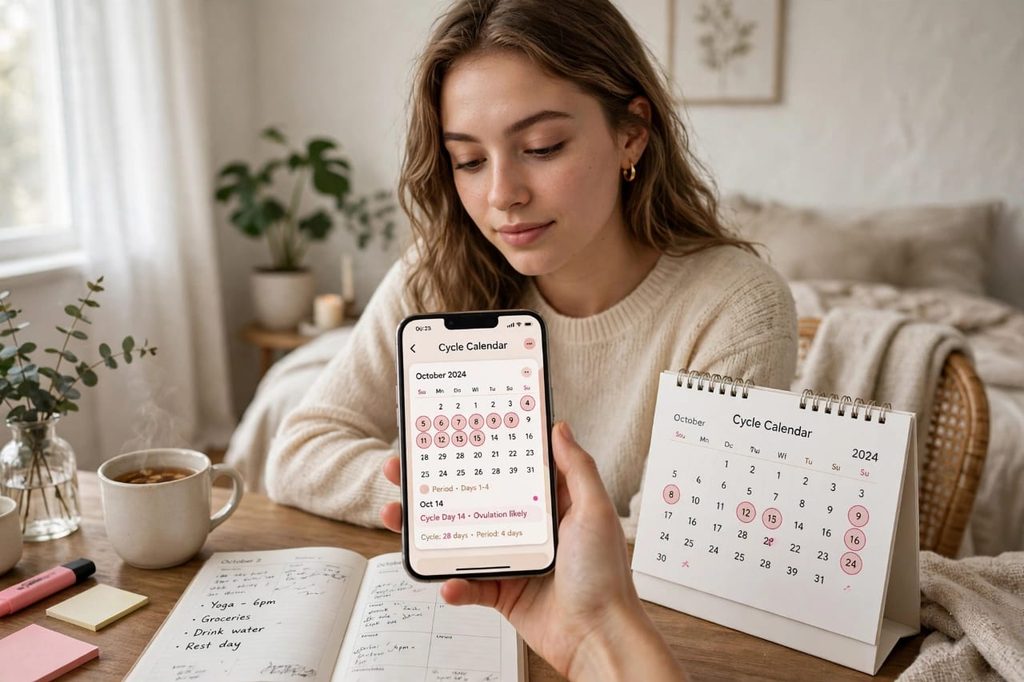
Table of Contents
What Is a Period Calculator?
A period calculator is a simple online tool that predicts your next period date, your fertile window, your ovulation day, and your PMS days.
You just have to enter two things:
- The first day of your last period
- Your average cycle length
That is it. The calculator does the rest of the math for you and shows you a full calendar for the next 3 to 6 months.
For example, if your last period started on November 1, and your cycle is 28 days, your next period will most likely start on November 29. Your ovulation will be around November 15. Your fertile window will be from November 10 to November 16.
Sounds simple, right? It is simple. But it can change your whole life because you will never be caught off guard again.
Why Should You Track Your Period?
Honestly, most women do not track their period until they face a problem. I think that is a mistake. Tracking is not just for pregnancy planning. It is for your health, your mood, your work, and your peace of mind.
Here are the real benefits:
- No More Surprises
You will know in advance when your period is coming. You can plan your travel, your office meetings, your wedding functions, and your gym routine accordingly. No more embarrassing moments at school or work. - You Understand Your Body Better
When you track for 3 months, you will start to see a pattern. You will notice that you get headaches 2 days before your period. Or you feel very hungry on day 20. Or you get mood swings on day 25. Once you know this, you stop blaming yourself. You understand it is just hormones. - It Helps If You Want To Get Pregnant
If you are trying for a baby, timing is everything. A period calculator shows you your 6 most fertile days. Many couples try for months without knowing this window, and they get disappointed. With correct tracking, your chances increase a lot. - It Helps If You Want To Avoid Pregnancy
On the other hand, if you are not planning a baby right now, knowing your fertile days also helps you to be more careful. But please remember, this is not 100% safe as a birth control method. I will explain this negative point in detail below. - It Helps Your Doctor
If you ever go to a doctor for irregular periods, the first thing she will ask is, “When was your last period? Is your cycle regular?” If you have 6 months of data saved, the doctor can diagnose you 10 times faster.

How To Use Our Free Period Calculator?
Our calculator is made for beginners. You do not need any medical knowledge.
Step 1: Enter First Day of Last Period
Think about the day your last period started. Not the day it ended. The first day of bleeding. Select that date from the calendar.
Step 2: Enter Your Cycle Length
Cycle length means the number of days from the first day of one period to the first day of the next period. For most women, it is between 21 to 35 days. The average is 28 days. If you are not sure, just put 28. You can change it later after tracking for 2-3 months.
Step 3: Enter Period Duration
How many days does your period usually last? For most women, it is 4 to 7 days. Enter that.
Step 4: Click Calculate
You will instantly see:
- Your next 3 period dates
- Your ovulation date
- Your fertile window
- Your safe days
- Your PMS start date
It takes less than 30 seconds. And the best part is, it is 100% free and private. We do not ask for your name, email, or any personal data.
How Does a Period Calculator Work? The Real Math
Many women ask me, “Is this calculator accurate? How does it know?”
It does not use magic. It uses simple average math.
Let’s say your cycle is 28 days.
Your last period: November 1.
Next period = November 1 + 28 days = November 29.
Ovulation usually happens 14 days before your next period.
So, Ovulation = November 29 – 14 days = November 15.
Fertile window is 5 days before ovulation + ovulation day itself. Because sperm can live inside the body for up to 5 days.
So, Fertile window = November 10 to November 16.
This formula works very well for women with regular cycles. If your cycle is 30 days, the calculator will automatically adjust it. If it is 25 days, it will also adjust.
But here is the honest truth. If your cycle is irregular, no calculator in the world can give you 100% accurate results. It can only give you an estimate. That is why you should track for at least 3 months to find your real average.
What Is a Normal Menstrual Cycle?
This is the question every teenage girl and every new mother asks.
A normal cycle is:
- Cycle Length: 21 to 35 days
- Period Duration: 3 to 7 days
- Blood Flow: Light to medium, not too heavy
- Pain: Mild cramps are normal, but you should still be able to do your daily work
If your cycle is 28 days one month, 29 days next month, and 27 days after that, do not panic. That is still considered regular. A difference of 2 to 3 days is completely normal.
Your cycle can change due to stress, travel, lack of sleep, weight loss, weight gain, or even change of weather. I have seen many women in the USA whose cycle becomes late during exam time or during holidays. That is your body’s way of reacting to stress.
When Is Your Period Considered Irregular?
You should pay attention if:
- Your cycle is less than 21 days or more than 35 days again and again
- You miss your period for 2-3 months without being pregnant
- Your period lasts more than 8 days
- You bleed very heavily and have to change your pad every 1 hour
- You have severe pain that stops you from going to work or school
- You bleed between periods
One irregular month is okay. Everyone has it. But if this happens for 3 months continuously, you should visit a doctor. It could be PCOS, thyroid problem, or hormonal imbalance. These are very common and treatable, but you should not ignore them.
Period Calculator for Pregnancy Planning
If you are trying to conceive, this tool is your best friend.
Your most fertile days are the 5 days before ovulation and the ovulation day itself. This is the time when you have the highest chance of getting pregnant.
For a 28-day cycle:
- Ovulation Day: Day 14
- Best Days: Day 11 to Day 16
Many doctors suggest trying on alternate days during this window instead of every single day. It keeps stress low and also improves sperm quality.
Also, do not just depend on the calculator. Look for ovulation signs in your body:
- Clear, stretchy discharge like egg white
- Slight increase in body temperature
- Mild pain on one side of your lower belly
- Increased desire
If you see these signs and they match your calculator date, then your timing is perfect.
And one more honest tip. If you have been trying for more than 12 months and you are under 35, or more than 6 months and you are over 35, please see a fertility doctor. Do not just keep trying alone. There is no shame in getting help.
Period Calculator for Avoiding Pregnancy – The Negative Truth
Now let’s talk about the negative side, because I do not want to give you false hope.
Many women use a period calculator as their only birth control method. This is called the rhythm method. And honestly, it is risky.
Why? Because:
- Ovulation can shift due to stress or illness. Even if your cycle is regular for 6 months, it can suddenly change.
- Sperm can live for 5 days. So even if you think you are in a safe zone, you might not be.
- The calculator is based on average, not your real body that month.
The failure rate of the rhythm method is around 24% per year. That means out of 100 women who use only this method, 24 get pregnant in one year. That is very high.
So my honest advice is: Use the period calculator for tracking and awareness, but if you really do not want a baby right now, use proper protection like condoms or birth control pills after talking to your doctor. Do not take a risk with your future.
Period Calculator vs Ovulation Calculator vs Due Date Calculator
Many women get confused between these three tools. Let me clear it in one line:
- Period Calculator: Tells you when your next period will come.
- Ovulation Calculator: Tells you when you will ovulate and what are your fertile days.
- Due Date Calculator: Tells you when your baby will be born if you are already pregnant.
Our period calculator actually gives you all three in one place. It shows your period dates, your ovulation date, and your fertile window. That is why it is more useful than other single-purpose tools.
PMS – Why Do You Feel So Bad Before Period?
PMS means Premenstrual Syndrome. Almost 75% of women feel it.
Common PMS symptoms are:
- Mood swings, crying without reason, feeling angry
- Bloating and weight gain of 1-2 kg
- Breast pain and tenderness
- Headache and back pain
- Acne on face
- Feeling tired and wanting to sleep all day
- Craving for chocolate, salty food, or junk food
PMS usually starts 5 to 7 days before your period and ends when your period starts.
The good news is, when you use a period calculator, you will know that PMS is coming. You can prepare for it. You can drink more water, avoid salty food, sleep early, and tell your family that you need some rest. Just knowing it is PMS makes it 50% easier to handle.
If your PMS is very severe and you feel depressed, or you cannot control your anger, please talk to a doctor. It could be PMDD, which is a more serious form of PMS, but it is treatable.
Tips To Keep Your Cycle Regular and Healthy
I am not a doctor, but these are the tips that doctors in the USA generally give:
- Sleep 7 to 8 hours. Lack of sleep directly affects your hormones.
- Do not do extreme dieting. Very low weight can stop your periods.
- Exercise, but do not over-exercise. 30 minutes of walk, yoga, or light exercise is perfect.
- Manage stress. Stress is the number 1 reason for late periods in young women.
- Eat iron-rich food during periods like spinach, red meat, and lentils.
- Drink 2 to 3 liters of water daily.
- Limit caffeine and alcohol during PMS days.
- Do not take period delay pills without asking a doctor.
Remember, your body is not a machine. It will have ups and downs. Be kind to yourself.
Pros and Cons of Using a Period Calculator – Honest Review
Pros:
- Free, fast, and easy to use
- Helps you plan travel, work, and social life
- Increases chances of pregnancy when used correctly
- Helps you detect irregular cycles early
- Gives you peace of mind and reduces anxiety
Cons:
- Not 100% accurate for irregular cycles
- Cannot be used as a reliable birth control method alone
- Can create false stress if you check it too much
- It cannot diagnose PCOS, thyroid, or other medical problems
- If you enter wrong last period date, all predictions will be wrong
So, use it as a guide, not as a final medical report. Your body knows better than any app.
Frequently Asked Questions – Period Calculator
Q: How many days after my period can I get pregnant?
A: You can get pregnant during your fertile window, which is usually 11 to 16 days after the first day of your period for a 28-day cycle. You are most fertile on ovulation day.
Q: My period is 5 days late. Am I pregnant?
A: Not necessarily. Stress, travel, illness, weight change, and hormonal imbalance can delay your period by 5 to 7 days. If you are sexually active and your period is more than 7 days late, take a pregnancy test.
Q: Can I use a period calculator if my cycle is irregular?
A: Yes, you can, but the results will be only an estimate. Track for at least 3 months and use the average cycle length. If it stays irregular, see a doctor.
Q: Is a 35-day cycle normal?
A: Yes, if it is consistently 35 days, it is still considered normal. Normal range is 21 to 35 days.
Q: Can stress delay my period?
A: Yes, 100%. Stress increases cortisol hormone, which can delay ovulation and then delay your period. This is very common during exams, job change, or family problems.
Q: When should I see a doctor?
A: If you miss 3 periods in a row, bleed for more than 8 days, have severe pain, or bleed very heavily, you should see a doctor immediately.
Q: Is this period calculator free?
A: Yes, our period calculator is 100% free. You do not need to sign up or give your email.
Final Verdict – Should You Use a Period Calculator?
My final verdict is simple. Yes, every woman should use it.
In 2026 and 2027, there is no reason to live with uncertainty. A free period calculator takes 30 seconds, but it saves you from months of stress and confusion.
Use our free Period Calculator above, enter your last period date, and see your next 3 period dates right now. Save the page, check it every month, and share it with your sister or friend who also needs it.
Your body deserves attention. Start tracking today, and you will thank yourself after 3 months.
Disclaimer: This calculator is for educational and tracking purposes only. It is not a substitute for medical advice. If you have any serious concerns about your cycle, please consult your doctor or gynecologist.
Pingback: Ovulation Calculator to Get Pregnant: 7 Proven Tips
Pingback: When Was I Conceived? - Free Fertilization Calculator
Pingback: Earliest HPT Calculator: 7 Best Early Test Tips
Pingback: Fertilization Calculator Pregnancy: Best Free Tool 2026