Calculate pay after taxes california 2026 is the main goal of this guide. If your salary is $3600 but you only get $2847, we will show you why with a real calculator.
If yes, you are not alone. I still remember my friend Alex in Los Angeles. He got his first job offer. The offer letter said $3600 a month. He was so happy. He planned his rent, his bike, everything. But when his first paycheck came, it was only $2847. He was literally shocked. He called me at 11 PM and said, “Shahid bhai, is this even legal? Company ne paisa kha liya kya?”
I laughed, but this is the reality for everyone working in California. It is legal. And it is the reality of working in the Golden State.
California is a beautiful state with great opportunities, Silicon Valley, Hollywood, everything. But it also has one of the most complicated and highest tax systems in the entire USA. So if you are searching on Google how to calculate take home pay in California or why is my paycheck so low, this guide will finally clear everything for you with real numbers.
In this article, I will show you the exact formula that payroll companies use, real breakdowns with examples of $3000, $5000, and $8000 salary, and the hidden deductions that no one tells you about. No boring theory, only practical talk.
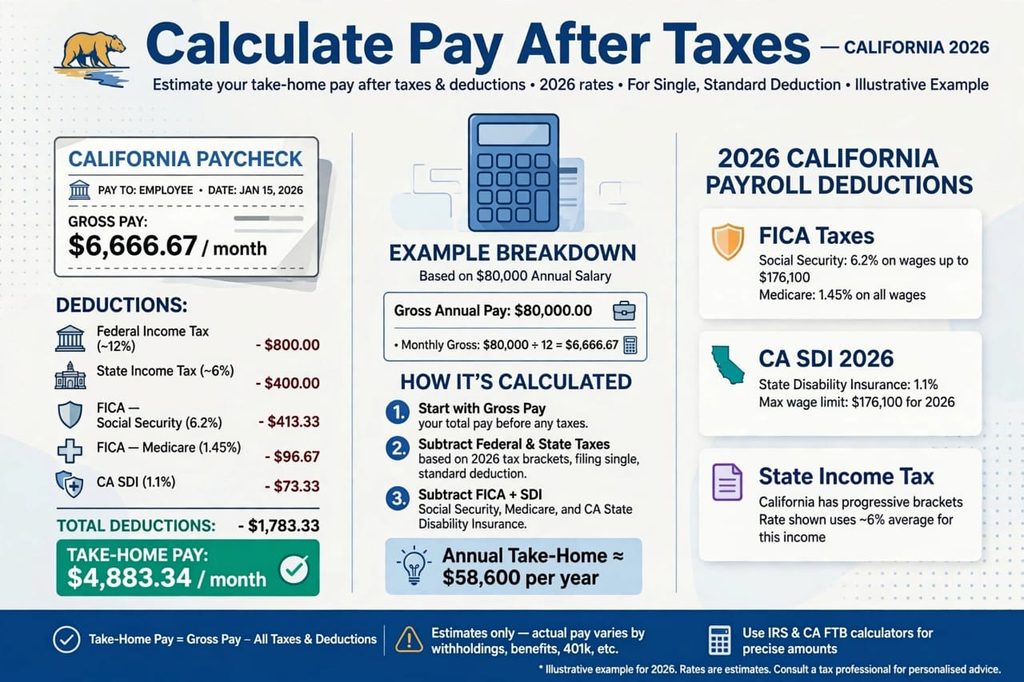
Table of Contents
What is Take-Home Pay Actually? Gross vs Net Pay
Before we calculate pay after taxes in California, you must understand two words. 90% of people confuse them and that is why they feel cheated.
1. Gross Pay: This is your total salary before any deductions. If your offer letter says $5000/month or $60,000/year, that is Gross Pay. This is just a number on paper. You never get this full amount.
2. Take-Home Pay (Net Pay): This is what actually comes to your bank account after all taxes and deductions. This is also called Net Pay or Real Pay. This is the money you can actually spend.
The simple formula that every HR uses is:
Take-Home Pay = Gross Pay – (Federal Tax + California State Tax + FICA + CA SDI + Other Deductions like 401k, Health Insurance)
Sounds simple, right? But in California, each of these has its own story and its own percentage. Let’s understand them one by one in detail.
How to Calculate Pay After Taxes California 2026 – Step by Step Breakdown
Let’s take a real example. Let’s say you live in Los Angeles and your gross salary is $5000 per month, which is $60,000 per year. You are single, no kids. How much will you actually take home? Let’s calculate.
Step 1: Federal Income Tax – The Biggest Chunk
This is taken by the IRS, the US Federal Government. This depends on your tax bracket. For 2026, federal brackets are from 10% to 37%. It is a progressive system. You don’t pay one flat rate on all your money.
For example, first $11,600 is taxed at 10%, next amount at 12%, then 22%, and so on. For a person earning $60,000 per year, you will technically be in the 22% bracket but your effective rate, the real rate you pay, is usually around 12-15% after standard deduction of $14,600 for 2026.
So for our $5000 example, let’s take Federal Tax as $750 (15%). If you have kids or are married, this will be less.
Step 2: California State Income Tax – Why California Paychecks Are So Low
This is the main reason why your paycheck in California is lower than your friend’s paycheck in Texas or Florida. Texas and Florida have 0% state tax. California has 9 tax brackets, from 1% to 13.3%. Yes, 13.3% is the highest in the whole country.
Here is the 2026 breakdown for Single Filers:
- Up to $10,412 income – 1% tax
- $10,412 to $24,684 – 2% tax
- $24,684 to $38,959 – 4% tax
- $38,959 to $54,081 – 6% tax
- $54,081 to $68,350 – 8% tax
- $61,214 to $78,664 – 9.3% tax
- Over $1,000,000 – 13.3% (Mental Health Services Surcharge)
So for a $5000/month ($60k/year) single filer, after standard deduction, your state tax will be around $250 to $300 per month (around 5-6% effective). This is higher than most states. This is the price you pay for living in California.
Step 3: FICA Taxes – Social Security and Medicare (7.65%)
This is mandatory for everyone in the USA, no matter which state you live in. It is non-negotiable.
It has two parts:
Social Security: 6.2% on up to $168,600 for 2026. This money goes to retired people. When you retire, you will get this money back as Social Security.
Medicare: 1.45% on all wages + 0.9% extra if you earn over $200k. This is for health insurance for people over 65.
Total FICA = 7.65%. On $5000, it is $382.50. The good thing is your employer pays the same amount again. So total 15.3% goes to government, but you only see 7.65% on your stub.
Step 4: CA SDI – The Hidden Tax Only Californians Pay
This is State Disability Insurance. Most new people who move to California don’t know about it. They search “what is SDI on my paycheck California?” California takes 1.1% of your wages for 2026 for SDI, up to a wage cap of $153,164.
On $5000, it is $55 per month. This is not taken in Texas or Florida. This gives you short-term disability and Paid Family Leave (PFL) benefits. If you get sick or need to take care of a new baby, California will pay you up to 60-70% of your wage for 8 weeks. So it is not fully wasted.
Step 5: Other Pre-Tax Deductions – 401k and Health Insurance
These are optional but important. If you put $500 in your 401(k) retirement account, your taxable income becomes $4500 instead of $5000. So you pay less tax today. Same with Health Insurance (medical, dental, vision). If your company takes $200 for health insurance, that is also pre-tax.
Final Real Calculation Example – $5000 Salary
So let’s do the final math for our $5000 example:
Gross Pay: $5000.00
– Federal Tax (15%): -$750.00
– California State Tax (5%): -$250.00
– FICA (7.65%): -$382.50
– CA SDI (1.1%): -$55.00
– Health Insurance (example): -$150.00
= Take-Home Pay: $3412.50
That means you lose almost 31.75% before you even see the money. If you have no health insurance, your take-home will be around $3562.50. This is the real answer to why is my paycheck so low.
3 Real World Examples – $3000, $5000, $8000 Salary
To make it even more clear, here are 3 real examples:
Example 1: $3000/month ($36k/year) – Entry Level Job
Gross: $3000
Deductions: ~$650 (Federal $300 + State $75 + FICA $229 + SDI $33)
Take-Home: ~$2350. This is why many people struggle with rent in LA on $3000 salary.
Example 2: $5000/month ($60k/year) – Mid Level
Gross: $5000
Deductions: ~$1437
Take-Home: ~$3562. This is the most common search.
Example 3: $8000/month ($96k/year) – Senior Level
Gross: $8000
Deductions: ~$2600 (You jump to 9.3% state bracket)
Take-Home: ~$5400. You lose almost 32.5% here.
Positive and Negative Side When You Calculate Pay After Taxes California – The Honest Truth
I want to be honest with you, as someone who has seen both sides of working in different states.
Negative Side (Why Your Paycheck Feels So Low):
- Highest State Tax in USA: California’s 13.3% top rate is the highest in the country. If you are a high earner, it hurts a lot.
- High Cost of Living + Low Take-Home: Rent in SF or LA is already $2000-$3000, and then low take-home makes it worse. Double pressure.
- SDI is Extra Burden: No other state takes this 1.1%. It feels like an extra penalty when you are new.
- Everything is Taxed: Gas tax, sales tax (7.25% to 10.5%), everything feels taxed here.
Positive Side (Where Your Money Actually Goes):
- You get SDI & PFL benefits: If you get sick or need family leave for a new baby, California pays you up to 60-70% of your wage for 8 weeks. Texas doesn’t give you a single dollar for this. My cousin used PFL for his baby and got $4000.
- Better Public Services: Your state tax funds some of the best universities in the world (UC system like UCLA, UC Berkeley), much better roads, and Covered California health programs.
- No Tax on Social Security for Retirees: Unlike many states, California doesn’t tax Social Security benefits. So when you retire, you save there.
- Strong Labor Laws: Daily overtime after 8 hours, meal breaks, paid sick leave. California protects employees more than any other state.
So yes, your paycheck is low today, but you are buying a safety net for tomorrow. It is a trade-off.
How to Increase Your Take-Home Pay in California – 5 Legal Ways
You can’t avoid taxes, but you can optimize and legally increase your take-home. Here are 5 ways I tell my friends:
1. Adjust Your W-4 Form: Many people have too much federal withholding. They get a big refund in April but less money every month. Use the IRS Tax Withholding Estimator tool and update your W-4 with your employer. You might get $100-200 more per month instantly. This is the easiest trick.
2. Use Pre-Tax Accounts – 401k, HSA, FSA: Put money in 401(k), HSA, or FSA. If you put $500 in 401k, your taxable income becomes $4500, so you pay less tax now. For 2026, you can put up to $23,500 in 401k tax-free. HSA is even better, triple tax-free.
3. Claim All Deductions and Credits: Are you a student? Paying student loan interest? You can deduct up to $2500. Have kids? Child Tax Credit is $2000 per kid. Don’t miss these.
4. Live in a Lower Tax Area? Not in CA but… All California cities have state tax, but sales tax varies. Los Angeles is 9.5%, but some cities are 7.25%. And if you can work remotely from Nevada or Texas for a few months, you can save big, but check residency rules.
5. Use Our Free Calculator: Instead of doing manual math every month, use the Free Tools Hub Pro – California Paycheck Calculator. It is free, updated for 2026 brackets including SDI, and gives you exact breakdown in 5 seconds. I built it after seeing Alex’s problem.
Common Mistakes People Make While Calculating Pay After Taxes
I see these mistakes daily in comments:
1. Forgetting CA SDI: Most online calculators like ADP or PaycheckCity forget California SDI. They show $55 more. Ours includes it, so it is more accurate.
2. Using Gross Instead of Taxable Income: If you contribute to 401k, your taxable income is lower. Calculate on Taxable Income, not Gross.
3. Not Including Overtime Correctly: Overtime in California is 1.5x after 8 hours/day and 2x after 12 hours. It is NOT taxed higher, but because you earn more in that pay period, you may temporarily jump to a higher withholding bracket, making it look like it is taxed more. You get it back in tax refund.
4. Confusing Bi-Weekly with Semi-Monthly: Bi-weekly is 26 paychecks a year, semi-monthly is 24. Your take-home per paycheck is different.
Final Verdict: Should You Worry If Your First Paycheck is Low?
If your first paycheck in California is low, don’t panic. It is 100% normal. Every single person who moves to California goes through this shock. The key is to understand the breakdown. Once you know how to calculate pay after taxes in California, you can plan your budget, rent, savings, and investments much better.
My personal advice: Use a calculator for accuracy, but understand the formula for confidence. Don’t just look at the final number, look at where your money is going. That SDI and State Tax is not wasted, it is building your future safety net in California.
So next time someone asks you “why is my paycheck so low in California?”, you will have the real answer with numbers, not just guesses.
Try our free tool at the top of this page to calculate your exact take-home pay in 10 seconds. Just enter your salary, pay frequency, and filing status. It is free forever.
Pingback: What Is Time and a Half? 5 Best Easy Examples