💖 When Was I Conceived?
Free Fertilization Calculator
I still remember the day my friend Sarah called me in a panic. She had just seen two pink lines on her pregnancy test, she was happy, scared, and confused all at the same time. And the first question she asked me was not about baby names or hospital. She asked, “When did I actually conceive? When was I conceived?”
If you are reading this right now, chances are you are asking the exact same question. Maybe you just found out you are pregnant. Maybe you are trying for a baby. Or maybe you are just curious and want to understand your body better. Whatever your reason is, you are in the right place. And trust me, you are not alone. Every single day, thousands of women in America search for this exact question: When was I conceived?
In this guide, I will explain everything in simple, human words. No difficult medical language. No confusing charts. Just a clear, honest explanation like a friend and a doctor would explain to you. We will talk about how fertilization really happens, how to calculate your conception date, what is accurate and what is not, and what doctors actually think about these calculators. By the end, you will know your date and you will also understand what it really means.
And yes, you can use our Free Fertilization Calculator at the top of this page. Just enter your last period date and cycle length, and you will get your fertilization date and due date in seconds.
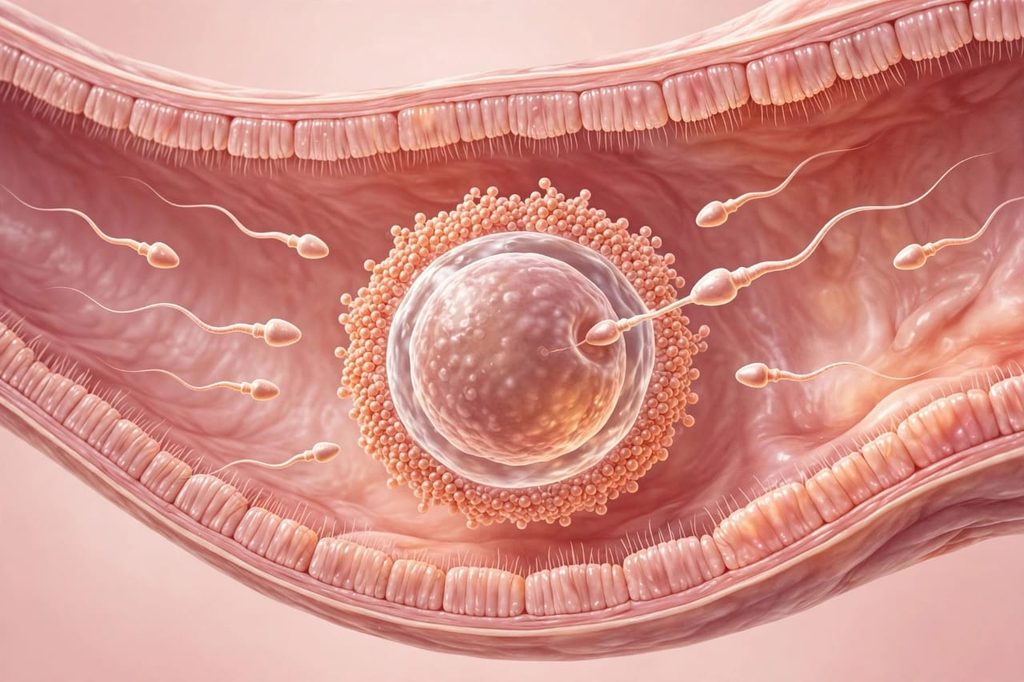
Table of Contents
What Does “When Was I Conceived” Really Mean?
When a woman says “When was I conceived?”, she usually means “On which day did the sperm meet my egg?” That exact moment is called fertilization. It is the moment when a new life begins.
But here is something most websites will not tell you clearly. Doctors use two different words: fertilization and conception. They sound the same, but they are slightly different.
Fertilization is the exact moment when one sperm enters the egg in the fallopian tube. It happens on ovulation day. It takes only a few minutes, but it changes everything.
Conception is a wider term. Doctors often use it to mean fertilization plus implantation. Implantation happens 6 to 10 days later, when the tiny fertilized egg attaches to the uterus wall. After implantation, your body starts making the pregnancy hormone hCG. That is when a pregnancy test turns positive.
So, when you ask “When was I conceived?”, you are actually asking for your fertilization date. And that is what our calculator gives you.
Let me give you a real-life example. Suppose your last period started on 2nd February 2026 and your cycle is 28 days. Your ovulation would be around 16th February 2026. That is your most likely fertilization date. Your due date would be around 9th November 2026. It is that simple when your cycle is regular.
How Does Fertilization Happen Inside Your Body? – Step By Step
Your body is doing something amazing every month, even when you do not feel it. Let me walk you through it like a story, step by step.
Step 1: Day 1 – Your Period Starts. This is the first day of your cycle. Your body sheds the old lining of the uterus. This is Day 1. Many women think the cycle starts after the period ends, but no, doctors count from the first day of bleeding.
Step 2: Egg Starts Growing. After your period, your brain sends a signal to your ovaries. One egg starts growing inside a small sac called a follicle. Think of it like a flower bud slowly opening. Other eggs also try to grow, but usually only one becomes the winner.
Step 3: Ovulation – The Big Day. Around the middle of your cycle, the mature egg is released. This is called ovulation. The egg travels into the fallopian tube. It stays alive for only 12 to 24 hours. This is your one golden chance in the whole month to get pregnant.
Step 4: Fertilization – The Meeting. If sperm is already waiting in the fallopian tube, one sperm will enter the egg. This is fertilization. And here is the amazing part: sperm can live inside your body for up to 5 days. So even if you had intercourse 3 or 4 days before ovulation, you can still get pregnant. The sperm waits patiently for the egg.
Step 5: Cell Division. After fertilization, the single cell starts dividing. 2, then 4, then 8, then 16. It slowly travels toward the uterus. It is a tiny journey, but a very important one.
Step 6: Implantation. After 6 to 10 days, this tiny ball of cells reaches the uterus and attaches to the wall. Some women feel light spotting or mild cramps here. This is called implantation bleeding. It is very light pink or brown, not like a normal period.
Step 7: Pregnancy Hormone Rises. After implantation, your body starts making hCG. This is the hormone that home pregnancy tests detect. That is why doctors say to wait until after your missed period to test. If you test too early, you may get a false negative even though you are pregnant.
How To Calculate When You Were Conceived? – Doctor’s Formula
Doctors do not guess. They use a simple, proven formula that has been used for decades.
Formula: Fertilization Date = First Day of Last Period + (Cycle Length – 14 Days)
Due Date Formula: Due Date = First Day of Last Period + 280 Days (40 Weeks)
From Conception: Due Date = Conception Date + 266 Days (38 Weeks)
Let me explain why we minus 14. In most women, the second half of the cycle, called the luteal phase, is almost always 14 days. It does not matter if your cycle is 26 days or 32 days, the time from ovulation to your next period is almost always 14 days. So doctors count backwards 14 days from your next period to find ovulation.
Real Example 1: Last Period = 2nd Feb 2026, Cycle = 28 Days. Next Period = 2nd March 2026. Minus 14 Days = 16th Feb 2026. So, Fertilization = 16th Feb 2026. Due Date = 9th Nov 2026.
Real Example 2: Last Period = 1st Nov 2026, Cycle = 30 Days. Ovulation = 17th Nov 2026. Due Date = 8th Aug 2027.
Real Example 3: Last Period = 11th Jan 2026, Cycle = 26 Days. Ovulation = 23rd Jan 2026. Due Date = 18th Oct 2026.
Our calculator does this math for you automatically. You do not need to do anything.

What Is Ovulation And Why Is It The Key To Everything?
If you understand ovulation, you understand 90% of conception. Ovulation is the release of a mature egg from your ovary. It happens only once in a cycle.
If your cycle is 28 days, ovulation is on Day 14. If your cycle is 30 days, ovulation is on Day 16. If your cycle is 26 days, ovulation is on Day 12. If your cycle is 35 days, ovulation is on Day 21.
But here is what many women do not know: you are not fertile for only one day. You are fertile for about 6 days. This is called the fertile window. It is 5 days before ovulation plus the day of ovulation. Why 5 days? Because sperm can live for 5 days inside you. The egg lives for only 1 day, but sperm waits for it.
So if you ovulate on 16th February, your fertile window is 11th to 17th February. If you have intercourse during these days, your chance of pregnancy is highest.
Some women feel ovulation signs: mild pain on one side of the belly, clear stretchy discharge like egg white, slightly higher body temperature, increased desire, and breast tenderness. Some women feel nothing at all. Both are completely normal.
Positive Points Of Knowing Your Conception Date – Why Doctors Like It
Knowing your conception date is not just curiosity. It has real medical benefits. Here are the positive points doctors agree on:
- 1. You Know Your Due Date Early: You can plan your doctor visits, ultrasounds, and maternity leave on time.
- 2. You Start Prenatal Vitamins On Time: Folic acid is most important in the first 4 weeks. Knowing early helps you protect your baby’s brain and spine development.
- 3. You Can Track Baby Growth Correctly: Your doctor compares baby’s size with your dates. If dates are correct, growth tracking is more accurate.
- 4. You Avoid Unnecessary Stress: Many women panic when they do not know dates. Knowing gives peace of mind.
- 5. You Can Avoid Harmful Things: Once you know you are pregnant, you stop alcohol, smoking, and certain medicines that can harm the baby.
- 6. It Helps In High-Risk Pregnancy: If you have diabetes, blood pressure, or thyroid, your doctor needs accurate dates to plan your treatment.
From a doctor’s point of view, this calculator is a great starting tool. It gives you a good estimate in seconds, for free, without any test.
Negative Points And Limitations – What Doctors Warn About
Now, let me be 100% honest with you, because a good article should tell you both sides. This calculator is helpful, but it is not perfect. Here are the negative points and limitations you must know:
1. It Assumes Your Cycle Is Regular: If your cycle changes every month, sometimes 28 days, sometimes 35 days, then the calculation can be off by 5 to 7 days. This is the biggest limitation.
2. Stress Can Shift Ovulation: Stress, travel, illness, weight loss, or weight gain can delay ovulation. If you were stressed that month, your ovulation may have happened 2-3 days late.
3. It Does Not Work Well For PCOS: Women with PCOS often do not ovulate every month, or ovulate very late. In that case, the calculator can give a wrong date. You need an ultrasound for confirmation.
4. It Cannot Tell The Exact Hour: Fertilization happens in a small window of 12 to 24 hours. No calculator can tell you the exact hour. It can only give you the most likely day.
5. Sperm Survival Confuses The Date: If you had intercourse on 10th and also on 16th, you might think you conceived on 10th. But actually, sperm from 10th waited and fertilized the egg on 16th. So the conception date is still ovulation day, not intercourse day. This confuses many couples.
6. It Is Not A Replacement For Ultrasound: Doctors always say, early ultrasound in the first trimester is the most accurate method. It can measure the baby and tell the date within 3 to 5 days. The calculator is an estimate, ultrasound is confirmation.
So, my honest advice: Use this calculator for planning and understanding, but for medical decisions, always visit your doctor.
Early Signs That Fertilization Has Happened
Many women ask me, “How will I know if fertilization happened?” The truth is, in the first few days, you will feel nothing. Fertilization is microscopic. You cannot feel it.
But after implantation, about 6 to 10 days later, you may notice some early signs:
- Light spotting, very light pink or brown, called implantation bleeding
- Mild cramps in lower belly, like period cramps but lighter
- Breast tenderness, swelling, and heaviness
- Feeling very tired and sleepy all day
- Nausea, especially in the morning
- Frequent urination
- Missed period – the biggest and clearest sign
- Heightened sense of smell, food suddenly smells strong
- Mood swings, feeling emotional without reason
Remember, these signs are not proof. Many women have no signs at all in early pregnancy and still have a healthy baby. And some women have all these signs but are not pregnant, just PMS. The only sure way is a pregnancy test after your missed period, or a blood test at the doctor.

Can You Get Pregnant On Your Period? – Honest Answer
This is one of the most searched questions on Google. The honest answer is: It is very unlikely, but not impossible.
If you have a 28-day cycle, you ovulate around Day 14, so having intercourse during your period (Day 1 to 5) is almost safe. But if you have a very short cycle, like 21 days, you may ovulate on Day 7, just 2 days after your period ends. Since sperm lives for 5 days, sperm from your period days could still be alive when you ovulate.
So, if you do not want pregnancy, never rely on “period is safe” method. Always use protection. Doctors do not recommend the calendar method alone as contraception.
What If You Have Irregular Cycles? – Doctor’s Advice
If your cycle is irregular, do not panic. Many women have irregular cycles, especially teenagers, women after stopping birth control pills, and women with PCOS or thyroid issues.
In this case, our calculator will still give you an estimate, but you should not rely on it 100%. The best options for you are:
1. Track For 3 Months: Write down your period dates for 3 months. Find your average cycle length. Use that average in the calculator.
2. Use Ovulation Test Strips: These strips detect LH hormone surge and tell you when ovulation is near. They are cheap and available in any pharmacy.
3. Check Basal Body Temperature: Your temperature rises slightly after ovulation. If you check it every morning, you can see the pattern.
4. Get An Early Ultrasound: This is the most accurate. Your doctor can measure the baby’s size and tell you the conception date within a few days.
If you have not had a period for more than 3 months, or your cycle is always less than 21 days or more than 35 days, please visit your doctor. Do not try to self-diagnose.
Fertilization vs Implantation vs Pregnancy – Clear Difference
Let me clear this confusion once and for all, in simple words:
Fertilization: Sperm meets egg in fallopian tube. Happens on ovulation day. This is Day 0.
Implantation: Fertilized egg attaches to uterus wall. Happens 6 to 10 days after fertilization.
Pregnancy: Officially starts after implantation, when hCG hormone starts rising. Your test becomes positive after this.
Example: If you conceived on 16th February, implantation would happen around 22nd to 26th February, and your test would become positive around 2nd to 5th March. That is why doctors tell you to wait until after missed period. Testing too early gives false negative.
Frequently Asked Questions (FAQs)
Q: How do I know when I conceived if I don’t remember my last period?
Check your period app, calendar, or messages. If you still don’t remember, an early ultrasound is your best option. Your doctor can estimate your due date from baby’s size.
Q: Can I conceive 2 days after ovulation?
No. Egg lives only 12 to 24 hours after ovulation. After that, it cannot be fertilized. You have to wait for next cycle.
Q: I had intercourse on 10th and 16th, which day did I conceive?
You most likely conceived on ovulation day, 16th. Sperm from 10th could have waited and fertilized egg on 16th.
Q: What is the difference between conception calculator and due date calculator?
Conception calculator tells you when you got pregnant. Due date calculator tells you when your baby will be born. Our tool gives you both at the same time.
Q: When should I take a pregnancy test?
Wait until at least 1 day after your missed period for best accuracy. For blood test, you can test a little earlier.
Q: Is it possible to conceive twice in one month?
Very rarely, a woman can release two eggs in same cycle. This can lead to fraternal twins. But it is very rare.
Q: Can stress delay conception date?
Yes. Stress can delay ovulation by 2-3 days. That is why your calculated date and ultrasound date can differ slightly.
Final Words – My Honest Advice For You
If you are reading this, you are already doing the right thing. You want to understand your body. That is the first step to a healthy pregnancy.
Knowing when you were conceived helps you plan better. You can know your due date, start your vitamins on time, plan your doctor visits, and track your baby’s growth week by week. It also gives you peace of mind. And peace of mind is very important in pregnancy.
But please remember one thing: This calculator is a great starting point, not the final answer. Use it, learn from it, but always confirm with your doctor and an early ultrasound. Your doctor knows your body, your history, and your health. No online tool can replace that.
Our Fertilization Calculator is free, fast, private, and easy to use. No data is saved. Everything happens in your browser. Use it, share it with your friends who are trying or expecting, and bookmark this page for future use.
Congratulations if you are pregnant. And if you are trying, I wish you all the best. Stay healthy, eat well, sleep well, and do not stress too much. Sometimes, the best thing you can do is relax and let nature do its work.
Disclaimer: This calculator and article are for information and educational purposes only. They are not a replacement for medical advice, diagnosis, or treatment. Always consult your doctor for confirmation and treatment. If you have heavy bleeding, severe pain, fever, or any emergency symptoms, visit your doctor or hospital immediately.