Ovulation calculator to get pregnant faster is the easiest way to understand your body and find your best fertile days.
If you are trying for a baby, timing is everything. Most women miss their fertile window because they guess it wrong. Our free ovulation calculator to get pregnant helps you track your most fertile days, your ovulation date, and your next period date in just 30 seconds, so you can plan with confidence and less stress.
You can eat healthy, take folic acid, and do everything right, but if you miss your fertile window, you miss the whole month. I have seen so many women feel frustrated, sad, and even blame themselves, when the real problem was simply that they did not know their exact ovulation days.
That is exactly why I created this guide around our free Ovulation Calculator. It is not a complicated medical tool. It is a simple, friendly, and private way to understand your body, track your most fertile days, and give yourself the best possible chance to get pregnant faster – without stress and without guessing.
In this article, I will walk you through everything like a friend would. What ovulation really is, how the calculator works, how to use it step by step, what signs your body gives you, what to do if your cycles are irregular, and the honest pros and cons that no one talks about. By the end, you will not feel confused anymore. You will feel confident.
So, grab a cup of tea, sit comfortably, and let us understand your cycle together.
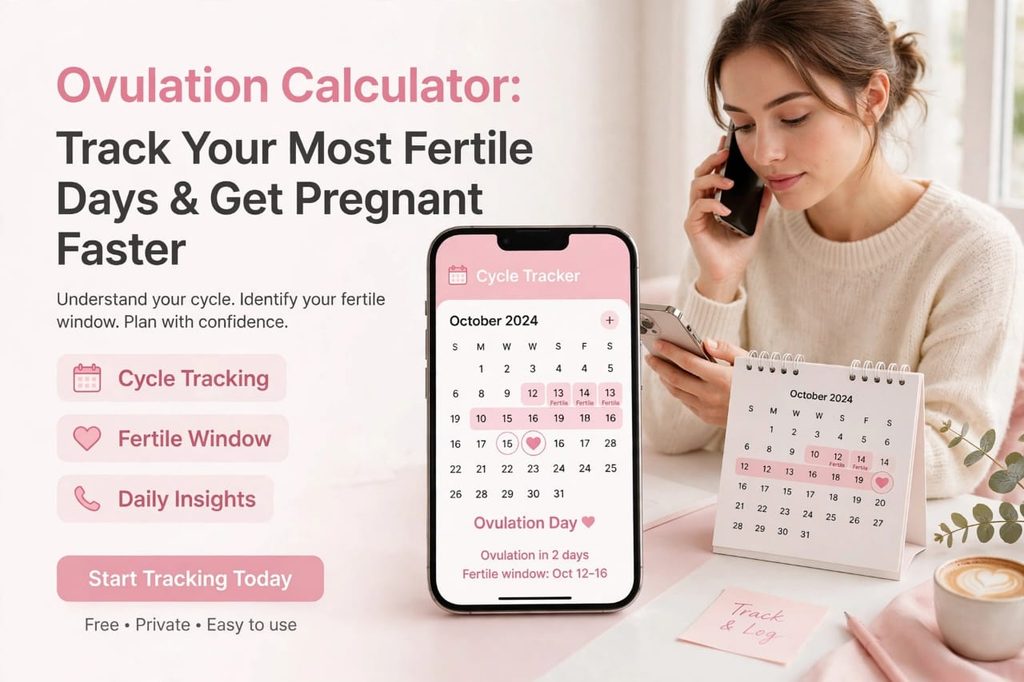
Table of Contents
What Is Ovulation, Really?
Let us keep it simple, no difficult doctor language.
Every month, your ovary releases one mature egg. That process is called ovulation. Once the egg is released, it travels down the fallopian tube, and it lives for only about 12 to 24 hours. That is a very short time.
But here is the good news: sperm can live inside the body for up to 5 days. That means you do not have to get the timing perfect to the exact hour. If sperm is already waiting when the egg is released, pregnancy can happen.
This is why we talk about a fertile window, not just one fertile day. Your fertile window is usually about 6 days long: the 5 days before ovulation, plus the ovulation day itself.
Many women think they can get pregnant any day of the month. That is not true. In reality, you have only about 6 days in each cycle when pregnancy is possible. And the highest chance is in the 2 to 3 days before ovulation and on ovulation day itself.
Once you understand this, you stop wasting energy worrying all month. You focus on those 6 golden days.
What Is an Ovulation Calculator?
An Ovulation Calculator is a free online tool that predicts your fertile window based on your menstrual cycle.
You just enter two simple things:
- The first day of your last period
- Your average cycle length, for example 28 days, 30 days, or 32 days
Within seconds, the calculator shows you:
- Your estimated ovulation date
- Your 6 most fertile days
- Your next period date
- Your next 3 to 6 months of fertile windows
Think of it like a personal calendar for your body. Instead of guessing, you get a clear plan.
I always tell my friends: If you are trying for a baby, tracking with a calculator is the first step, not the last step. It gives you direction.
How Does the Ovulation Calculator Work?
The science behind it is actually very simple.
For most women with regular cycles, ovulation happens about 14 days before the next period starts. This is called the luteal phase, and it is surprisingly stable.
So, if your cycle is 28 days long:
28 – 14 = Day 14 is your ovulation day.
If your cycle is 30 days long:
30 – 14 = Day 16 is your ovulation day.
If your cycle is 32 days long:
32 – 14 = Day 18 is your ovulation day.
Your fertile window then starts 5 days before that ovulation day.
Example: Let us say your last period started on November 1, and your cycle is 28 days.
Your next period will be around November 29.
Your ovulation day will be around November 15.
Your fertile window will be November 10 to November 15.
The calculator does this math for you automatically, for the next several months, so you can plan ahead. That is especially helpful if you and your partner have busy work schedules, travel plans, or you want to plan around holidays.
How To Use Our Ovulation Calculator Step By Step
Using our calculator is easier than ordering food online. Here is how:
Step 1: Enter First Day of Your Last Period
Open the calculator at the top of this page. Enter the date your last period started. Be as accurate as you can. If you are not sure, check your period tracking app or calendar.
Step 2: Enter Your Average Cycle Length
If you are not sure, 28 days is the average. But if your cycles are usually 30, 31, or 35 days, enter that number. For best results, look at your last 3 cycles and take the average. For example, if your last 3 cycles were 28, 30, and 29 days, your average is 29 days.
Step 3: Click Calculate
Click the Calculate button. In less than a second, you will see your full fertility calendar.
Step 4: Save Your Results
Take a screenshot or note down your fertile days in your phone. Mark the top 2 most fertile days with a heart. Share it with your partner if you feel comfortable. Planning together makes it less stressful and more like teamwork.
That is it. No sign-up, no download, no personal information needed. It is 100% free and private.

Signs Your Body Gives You That Ovulation Is Near
The calculator is powerful, but your body also talks to you. When you learn to listen to both, your accuracy goes up a lot. Here are the most common signs:
- Clear, Stretchy Cervical Mucus
This is the number one sign. Around ovulation, your discharge becomes clear, slippery, and stretchy like raw egg white. This is your body helping sperm travel faster. If you see this, you are in your fertile window. - Mild Cramps On One Side
Some women feel a light pinch or cramp on one side of the lower belly. This is called Mittelschmerz. It is normal and it can last from a few minutes to a few hours. - Slight Rise In Body Temperature
After ovulation, your basal body temperature rises by about 0.5 to 1 degree Fahrenheit. If you track your temperature every morning before getting up, you will start to see a pattern. - Increased Sex Drive
This is completely natural. Nature designed it this way. Around ovulation, many women feel more energetic, more confident, and more interested in intimacy. - Tender Breasts And Bloating
Due to hormonal changes, you may feel slight breast tenderness or bloating. It is similar to PMS, but it happens mid-cycle. - Heightened Sense of Smell
Some women notice they become more sensitive to smells around ovulation. It is subtle, but it is real.
You do not need to have all these signs. Even 2 or 3 signs, combined with the calculator, are enough to confirm your fertile window.
The Honest Truth: Positive And Negative Sides of Ovulation Calculators
I want to be 100% honest with you, because this is about your dream of becoming a mother. No tool is perfect. Let us talk about both sides like real people.
The Positive Side – Why Women Love It
- It Removes Guessing And Stress
Instead of wondering all month, Am I ovulating today? you have a clear plan. That alone reduces stress, and lower stress actually helps fertility. - It Is Free, Private, And Fast
You do not need to buy expensive kits every month. You can check it on your phone in 30 seconds, at home, privately. - It Helps You Plan Your Life
You can plan trips, work, and intimate time around your fertile days. Couples tell me this changed everything for them. They stopped fighting about timing and started working as a team. - It Helps You Understand Your Body
After 2 to 3 months of tracking, you will start to understand your own pattern. You will know if you are regular or irregular. That knowledge is powerful when you talk to a doctor. - It Increases Your Chances
Studies show that couples who time intercourse to the fertile window have a much higher chance of conceiving in the first 3 to 6 months than couples who do not track at all.
The Negative Side – What You Must Know
- It Is An Estimate, Not A Guarantee
The calculator works on averages. Your body is not a machine. Stress, illness, travel, lack of sleep, or hormonal changes can shift ovulation by 2 to 3 days. So, do not treat the date as 100% fixed. - It Is Less Accurate For Irregular Cycles
If your cycle varies from 24 days one month to 38 days the next month, the calculator alone will not be enough. In that case, you should also use ovulation predictor kits or track cervical mucus. - It Cannot Detect Medical Issues
The calculator cannot tell you if you have PCOS, thyroid problems, blocked tubes, or low sperm count. If you have been trying for more than 12 months under age 35, or more than 6 months over age 35, please see a doctor. That is not failure. That is smart. - It Can Create Pressure
This is the emotional side no one talks about. Some couples start to feel like intimacy is a chore or a task on a calendar. If you feel that pressure, take a step back. Take a break for one month. Love and connection matter more than a perfect schedule.
My honest advice: Use the calculator as a guide, not as a rule. Let it help you, not control you.
What If Your Periods Are Irregular?
This is the most common question I get, and it is so important.
If your periods are irregular, do not panic. It is more common than you think, especially after stopping birth control pills, after childbirth, during breastfeeding, or if you have PCOS.
Here is what to do:
Track for 3 months first. Write down the first day of each period. Find your shortest cycle and your longest cycle. Your fertile window will be wider, but you can still estimate it.
Use the calculator with your shortest cycle and also with your longest cycle. That will give you a range, not just one date.
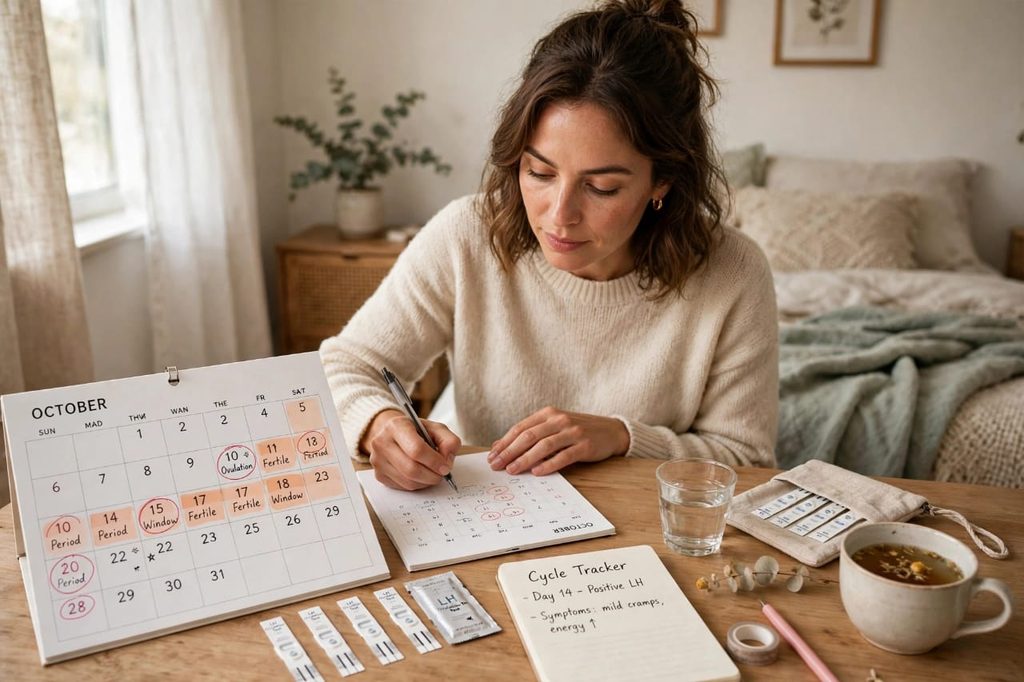
Combine it with other methods. Use ovulation predictor strips, which detect LH surge in urine. They are cheap and available at any pharmacy. Use them from day 10 onwards if your cycle is irregular.
Watch your cervical mucus. This is often more reliable than dates for irregular cycles.
And most importantly, talk to your gynecologist. Irregular cycles are treatable in most cases. A simple blood test and ultrasound can find the cause.
Remember, irregular does not mean impossible. It just means you need a little more patience and support.
Best Days To Try For Pregnancy – The Perfect Plan
If you want a simple plan that works for most couples, here is what doctors usually recommend:
Do not wait only for ovulation day. Start earlier.
Try every other day during your 6-day fertile window. For example, if your fertile window is November 10 to 15, try on November 10, 12, and 14, and also on the 15th if you feel up to it.
Why every other day? Because it keeps sperm count high and keeps stress low. Trying every single day can be exhausting and can actually lower sperm quality slightly.
Also, try in the morning or evening when you are both relaxed. Avoid alcohol, smoking, and too much caffeine during this time. Eat healthy, drink water, and get good sleep.
And please, after intimacy, do not stress about lying with legs up for hours. There is no strong scientific proof that it helps. Just relax for 10 to 15 minutes, cuddle, and enjoy the moment. That peace of mind is more helpful than any trick.
Common Mistakes Women Make When Tracking Ovulation
I have seen these mistakes again and again, so let me save you time:
Mistake 1: Assuming Day 14 Is Always Ovulation Day
Day 14 is only true if your cycle is exactly 28 days. If your cycle is 32 days, your ovulation is around Day 18. Always calculate based on YOUR cycle length.
Mistake 2: Only Trying On Ovulation Day
By the time you ovulate, you have already missed 5 fertile days. Sperm needs to be waiting. Start 5 days before.
Mistake 3: Using Only An App And Ignoring Body Signs
Apps and calculators are great, but they are based on math. Your body signs are based on real hormones. Use both together.
Mistake 4: Taking A Pregnancy Test Too Early
I know the waiting is the hardest part. But testing before your missed period often gives a false negative and breaks your heart for no reason. Wait until at least 1 day after your missed period for the most accurate result.
Mistake 5: Comparing Yourself To Others
Your friend got pregnant in the first month. Another friend took 11 months. Both stories are normal. Every body is different. Your journey is yours alone.
How To Increase Your Chances Naturally
Beyond tracking, here are 7 small, proven habits that really help:
- Take Folic Acid Daily
Start taking 400 mcg of folic acid at least 1 month before trying. It helps prevent birth defects and supports healthy ovulation. - Maintain A Healthy Weight
Being very underweight or overweight can affect ovulation. You do not need to be perfect. Just aim for a balanced, sustainable weight. - Eat Fertility-Friendly Foods
Leafy greens, eggs, nuts, lentils, berries, salmon, and whole grains are excellent. Reduce processed food, sugary drinks, and too much caffeine. - Stop Smoking And Limit Alcohol
Both can reduce fertility in men and women. If you are trying, this is the best time to quit. - Manage Stress
Chronic stress can delay ovulation. Try walking, prayer, meditation, journaling, or talking to someone you trust. You do not have to carry this alone. - Get Enough Sleep
Aim for 7 to 8 hours. Your hormones balance themselves while you sleep. - Ask Your Partner To Get Checked Too
Fertility is not just a woman’s responsibility. About 40% of fertility issues are male-related. A simple sperm test can save months of confusion.
These are small changes, but together they make a big difference.
Ovulation Calculator For Boy Or Girl – Is It True?
Many women ask me: Can I use the ovulation calculator to choose a boy or girl?
There is a popular theory called the Shettles Method. It says that timing intercourse close to ovulation favors a boy, because male sperm swim faster, while timing 2 to 4 days before ovulation favors a girl, because female sperm live longer.
I want to be honest: There is no strong scientific proof that this works 100%. Some couples swear by it, others say it did not work for them. It is fun to read about, but please do not put pressure on yourself to choose gender. The most important thing is a healthy baby, whether boy or girl.
Use the calculator to get pregnant first. Gender is a beautiful surprise.
When Should You See A Doctor?
Tracking at home is wonderful, but there are times when you need professional help. Please see your doctor if:
- You are under 35 and have been trying for more than 12 months
- You are over 35 and have been trying for more than 6 months
- Your periods are very irregular, very painful, or missing for months
- You have PCOS, endometriosis, thyroid issues, or a history of miscarriage
- Your partner has known fertility issues
Going to a doctor does not mean something is wrong with you. It means you are taking charge of your health. Most fertility issues today are treatable, and doctors have helped millions of couples become parents.
Do not feel shy or ashamed. You deserve support.
Final Thoughts: Your Journey Matters
I know trying for a baby can feel like an emotional rollercoaster. One month you feel hopeful, the next month you feel heartbroken when your period arrives. I have heard this story from so many women, and I want you to know: your feelings are valid.
But please remember this: You are not broken. You are not late. You are not alone.
An Ovulation Calculator cannot guarantee pregnancy, but it can give you clarity, confidence, and a plan. And sometimes, that clarity is exactly what you need to keep going with hope.
Use our free Ovulation Calculator at the top of this page today. Find your fertile window, make a plan with your partner, take care of your body and your heart, and trust the process.
I am rooting for you. I hope very soon, you get to see those two beautiful pink lines.
Good luck, and lots of love and prayers for you.
Frequently Asked Questions (FAQs)
Q1. How accurate is the Ovulation Calculator?
For women with regular cycles, it is about 90% accurate for predicting the fertile window. For irregular cycles, it is less accurate, so you should also track cervical mucus and use ovulation test strips for best results.
Q2. How many days after my period do I ovulate?
If your cycle is 28 days, you usually ovulate around Day 14, which is about 14 days after your period starts. If your cycle is 30 days, you ovulate around Day 16. It depends on your cycle length.
Q3. What are the 6 most fertile days?
Your fertile window includes the 5 days before ovulation plus the ovulation day itself. These are the only 6 days in your cycle when pregnancy is possible.
Q4. Can I get pregnant 2 days before ovulation?
Yes, absolutely. In fact, 2 days before ovulation is one of the best days to try, because sperm can live for up to 5 days and will be waiting when the egg is released.
Q5. Can I get pregnant after ovulation?
The egg lives for only 12 to 24 hours after ovulation, so your chance drops very quickly after ovulation day. That is why it is better to try before ovulation, not after.
Q6. Can I use the Ovulation Calculator if I have PCOS?
Yes, you can use it as a starting point, but with PCOS ovulation can be delayed or unpredictable. You should also use ovulation predictor kits and talk to your doctor.
Q7. When should I take a pregnancy test after ovulation?
Wait until at least 14 days after ovulation, or 1 day after your missed period. Testing too early can give a false negative.
Q8. Is the Ovulation Calculator free?
Yes, our Ovulation Calculator on this page is 100% free, private, and you do not need to sign up or download anything.
Pingback: Fertilization Calculator Pregnancy: Best Free Tool 2026