Are you working extra hours in California and still confused why your paycheck does not match your hard work? You are not alone. I still remember last month when my friend Ali, who works in a warehouse in Los Angeles, called me. He said, “Shahid bhai, I worked 55 hours this week but my paycheck increased by only $70. Is my company cheating me?” When we checked his hours, we found his employer was not paying him daily overtime correctly.
That is the exact reason we built this California Overtime Calculator 2026-27. California has the most complicated and the most employee-friendly overtime laws in the entire United States. In 49 other states, you only get overtime after 40 hours a week. But in California, you get overtime after just 8 hours a day. This means you can earn much more, but only if you know how to calculate it correctly. In this complete guide, I will explain everything in very simple English, with real-life examples, formulas, updated 2026-27 minimum wage rules, pros and cons, and honest personal experience.
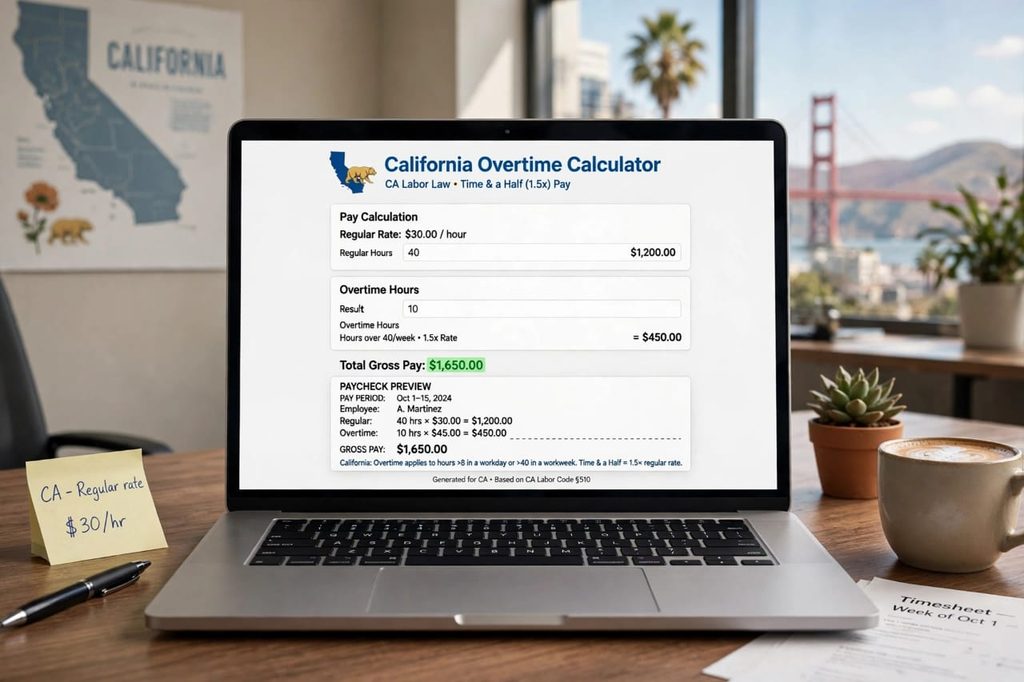
Table of Contents
What is a California Overtime Calculator?
A California Overtime Calculator is a free and advanced online tool that is specially designed for California Labor Code Section 510. Unlike a normal overtime calculator that only calculates weekly overtime, our tool calculates daily overtime, weekly overtime, and even double time according to California law.
Why is a special calculator needed for California? Because California law is unique. A regular calculator from Texas or New York will show you zero overtime if you worked 10 hours on Monday but only 30 hours in the whole week. But under California law, you legally earned 2 hours of time and a half for that Monday. Most national payroll software also makes this mistake. That is why thousands of workers in California lose hundreds of dollars every month without even knowing it.
Our tool fixes this problem. You just enter your regular hourly rate and your hours, and it instantly breaks down your pay into three parts: Regular Pay, Time and a Half Pay (1.5x), and Double Time Pay (2x). It is 100% free, accurate, and updated for 2026-27 laws.
What is Time and a Half? Complete Explanation
Time and a half is a term that confuses many new workers in the USA, especially immigrants. Let me explain it in the simplest way possible. Time and a half simply means 1.5 times your normal hourly rate. The word “time” means your regular rate, and “a half” means half of your regular rate extra.
The Main Formula is: Time and a Half = Regular Hourly Rate x 1.5
Let’s understand with very simple examples. If you earn $20 per hour normally, your time and a half will be $20 x 1.5 = $30 per hour. If you earn $25 per hour, your time and a half will be $37.50 per hour. If you earn $30 per hour, it will be $45 per hour. This extra 50% is a penalty for the employer for making you work extra hours, and a reward for you for your extra hard work. To understand the federal base, you can also read about Time and a Half pay on the US Department of Labor website.
Many people ask, is time and a half mandatory? Yes, in California, it is mandatory by law. Your employer cannot say “we don’t pay overtime.” If they do, they are violating the law.
California Overtime Laws 2026-27 – Latest Update
For 2026-27, there is one major update you must know. The California minimum wage has increased to $16.50 per hour for all employers, regardless of size. This means even if you are a minimum wage worker, your overtime rate is now at least $24.75 per hour (1.5x) and double time is $33.00 per hour. If your employer is still paying you based on the old $16.00 rate, they are underpaying you.
California overtime law is divided into 4 very important rules. You must understand all 4 to calculate your pay correctly.
1. Daily Overtime Rule – After 8 Hours in a Day
This is the most important and most beneficial rule for California workers. Under Labor Code 510, if you work more than 8 hours in a single workday (not workweek, workday), you must be paid time and a half for all hours from 8 to 12. For example, you work 10 hours on Monday. You will get 8 hours regular pay + 2 hours overtime pay, even if you work only 30 hours that whole week. No other state in America has this daily rule.
2. Double Time Rule – After 12 Hours in a Day
This rule exists ONLY in California. It is what makes California special. If you work more than 12 hours in a single workday, you must be paid double time, which is 2x your regular rate, for all hours beyond 12. For example, if you work 13 hours in a day, the 13th hour will be paid at double rate. Imagine you earn $25/hour, your 13th hour will be $50/hour. This rule was made to prevent employers from forcing workers to work extremely long shifts.
3. Weekly Overtime Rule – After 40 Hours in a Week
This is the standard rule that exists in all of America. If you work more than 40 hours in a single workweek, all hours beyond 40 must be paid at time and a half (1.5x). This is calculated after daily overtime is calculated. Sometimes you can get both daily and weekly overtime in the same week, but your employer must pay you the higher amount, not both combined.
4. Seventh Consecutive Day Rule – The Most Powerful Rule
This is a rule that 90% of workers don’t know about, and employers often hide it. If you work 7 consecutive days in a workweek, your employer must pay you special rates on the 7th day. For the first 8 hours on the 7th day, you must get 1.5x pay. And for any hours beyond 8 hours on that 7th day, you must get double time (2x). So if you work 10 hours on the 7th day, you will get 8 hours at 1.5x and 2 hours at 2x. This can make your 7th day the highest-paid day of the week. For full official details, you can check California Overtime Laws on the official government site.
How to Use Our Time and a Half Calculator? Step-by-Step Guide
We have made our California Overtime Calculator very simple. You do not need to create an account or download anything. Even my friend who is not good with computers can use it in 10 seconds.
Step 1: Enter Your Regular Hourly Rate: First, enter your normal pay rate without overtime. For example, if you earn $25 per hour, enter 25. If you are a salaried employee, divide your monthly salary by total hours to get hourly rate.
Step 2: Enter Your Hours Worked: Enter how many hours you worked. You can enter daily hours like 10, 11, 13 or you can enter weekly hours like 45, 50, 60. For best accuracy in California, always calculate daily first.
Step 3: Select Calculation Type: Select whether you want to calculate for a single day or a whole week. Our tool automatically applies both daily and weekly rules.
Step 4: Click Calculate Button: As soon as you click calculate, you will see a complete breakdown: How much is your Regular Pay, how much is your Overtime Pay at 1.5x, how much is your Double Time Pay at 2x, and what is your Total Gross Pay for that day or week. You can also use this result to cross-check your employer’s paycheck.
Real Life Example – $25 an Hour is How Much Overtime?
Let me explain with a real-life example that happened with my friend Ali. Ali earns $25 per hour in California and last Tuesday he worked 13 hours in one shift because there was extra shipment in the warehouse.
Here is how his pay for that single day should be calculated under California law:
Regular Pay Calculation: First 8 hours x $25 = $200
Time and a Half Pay Calculation: Next 4 hours (from 8 to 12 hours) x $37.50 = $150
Double Time Pay Calculation: Last 1 hour (after 12 hours) x $50 = $50
Total Pay for That One Day = $200 + $150 + $50 = $400
Now think about this. If Ali used a normal calculator from Google that is made for Texas, that calculator would show only $200 for that day because Ali did not cross 40 hours for the week yet. But under California law, Ali legally earned $400 for that single day. That is a $200 difference for just one day. In one month, this difference can be more than $800. This is why you must always use a California-specific overtime calculator.
Time and a Half Pay Chart 2026-27 – Quick Reference
We know you don’t want to calculate every time. So we have created a ready-made chart for the most common hourly rates in California for 2026-27. This chart is based on the new minimum wage of $16.50. You can bookmark this page or take a screenshot of this chart.
| Regular Hourly Rate | Time and a Half Rate (1.5x) | Double Time Rate (2x) |
|---|---|---|
| $16.50 (CA Minimum Wage 2026) | $24.75 | $33.00 |
| $18.00 | $27.00 | $36.00 |
| $20.00 | $30.00 | $40.00 |
| $22.50 | $33.75 | $45.00 |
| $25.00 | $37.50 | $50.00 |
| $28.00 | $42.00 | $56.00 |
| $30.00 | $45.00 | $60.00 |
| $35.00 | $52.50 | $70.00 |
| $40.00 | $60.00 | $80.00 |
Advantages and Disadvantages of Overtime in California – Honest Review
Working overtime looks very attractive because of extra money, but it has both good and bad sides. As someone who has seen many friends work overtime for years, I want to give you an honest review with both positive and negative points.
Positive Points – Advantages of Overtime
1. Extra Income and Fast Savings: This is the biggest positive point. With overtime, you can easily earn 30% to 50% more per month. For example, if your normal salary is $4000, with 10 hours of overtime per week, you can make $5500. Many immigrants in California use overtime to pay off their debts and support their families back home faster. It is one of the fastest ways to save money legally.
2. Best Employee Protection in the USA: California law is written to protect you, not the company. Your employer cannot force you to work extra without paying the premium rate. If they do not pay you correctly, you can file a wage claim with the Labor Commissioner and get up to 3 years of back pay. This protection does not exist in other states.
3. Skill Growth and Promotion: When you work extra hours, you learn the job faster than others. You get more experience, you understand the system better, and managers notice your hard work. Many people who do overtime regularly get promoted to supervisor or manager positions much faster.
Negative Points – Disadvantages of Overtime
1. Higher Taxes – The Hidden Trap: This is the biggest negative point that no one tells you about. Overtime pay is taxed at a higher rate. Sometimes you work 10 extra hours, but you only take home pay for 6 hours. Why? Because the extra income pushes you into a higher federal tax bracket. Your federal tax can jump from 12% to 22% on overtime money. That is why your paycheck looks smaller than what you calculated. Always use a take-home pay calculator to see your real after-tax pay.
2. Burnout, Health Issues, and Family Time Loss: This is a very serious negative point. I have seen my friends working 60-70 hours a week in Amazon warehouses and hospitals. After 3-4 months, they face severe burnout, back pain, sleep problems, and anxiety. They have no time for family, no time for gym, and no time for life. Money is important, but health is more important. Working 12-13 hours daily for a long time is not sustainable and can damage your body permanently.
3. Employer Misuse and Pressure: Some bad employers intentionally hire fewer people. Instead of hiring 10 people for 40 hours, they hire 7 people and force them to work 60 hours each. This saves them money on health insurance and benefits, but it puts extreme pressure on workers. If your company is forcing you to work overtime without your consent, that is illegal. You have the right to say no in many situations.
How to Avoid Tax Problems on Overtime Pay?
A very common question we get is, “Why is my overtime paycheck taxed so much?” The answer is the US progressive tax system. To avoid shock, you should do three things. First, adjust your W-4 form correctly so less tax is withheld. Second, always calculate your after-tax overtime pay using a California Take Home Pay Calculator before you agree to work extra. Third, try to keep your total hours under 55 per week if you are already in the 22% tax bracket, because beyond that, you work more but keep less.
Final Verdict – Should You Work Overtime in California in 2026-27?
After explaining all the pros and cons, here is my final honest verdict. If you are young, single, and your goal is to save money quickly for the next 1-2 years, then overtime in California is one of the best legal opportunities in the whole USA. With laws like daily overtime and double time, you can easily earn an extra $800 to $1200 per month. It can change your financial life.
But if you are working more than 60 hours a week continuously for many months, please take care of your health. No amount of money is worth your health, your sleep, and your family time. Use our California Overtime Calculator 2026-27 to always check if your employer is paying you correctly. Bookmark this page, check your paycheck every single week, and do not let any employer steal your hard-earned overtime money. Your hard work deserves correct pay.
Frequently Asked Questions (FAQs)
How much is time and a half for $20 an hour in California?
Time and a half for $20 an hour is $30 per hour in California. Double time for $20 an hour is $40 per hour. So if you work 10 hours at $20/hour, you will earn $220 for that day (8×20 + 2×30).
Is daily overtime mandatory in California in 2026?
Yes, daily overtime is 100% mandatory in California in 2026-27. After 8 hours in a workday, you must get 1.5x and after 12 hours, you must get 2x. This is confirmed by the Department of Industrial Relations and the US Department of Labor.
What is the 7th day rule in California overtime?
If you work 7 consecutive days in a workweek, your employer must pay you 1.5x for the first 8 hours on the 7th day and 2x for all hours after 8 hours on the 7th day. This is one of the highest paying rules in California.
Does California have double time after 12 hours?
Yes, California is the only state in the USA where double time after 12 hours in a single workday is mandatory by law. No other state has this rule.
How to calculate overtime for $30 an hour in California?
For $30 an hour, your time and a half rate is $45 per hour and double time rate is $60 per hour. If you work 12 hours at $30/hour, your total pay for the day will be $420 (8×30 + 4×45).