Last month, one of my close friends in Texas called me and said, “Shahid bhai, I worked 48 hours this week but my boss only paid me my normal rate. Is this fair?”
I told him, No, that’s not fair at all. In the USA, if you work more than 40 hours, you should get time and a half. And honestly, 90% of hourly workers don’t even know how to calculate it properly. That’s why their paycheck is always confusing.
So today, I will explain to you what is time and a half in super simple language, like I am explaining to my own brother. No boring law language, just real examples you can use today.
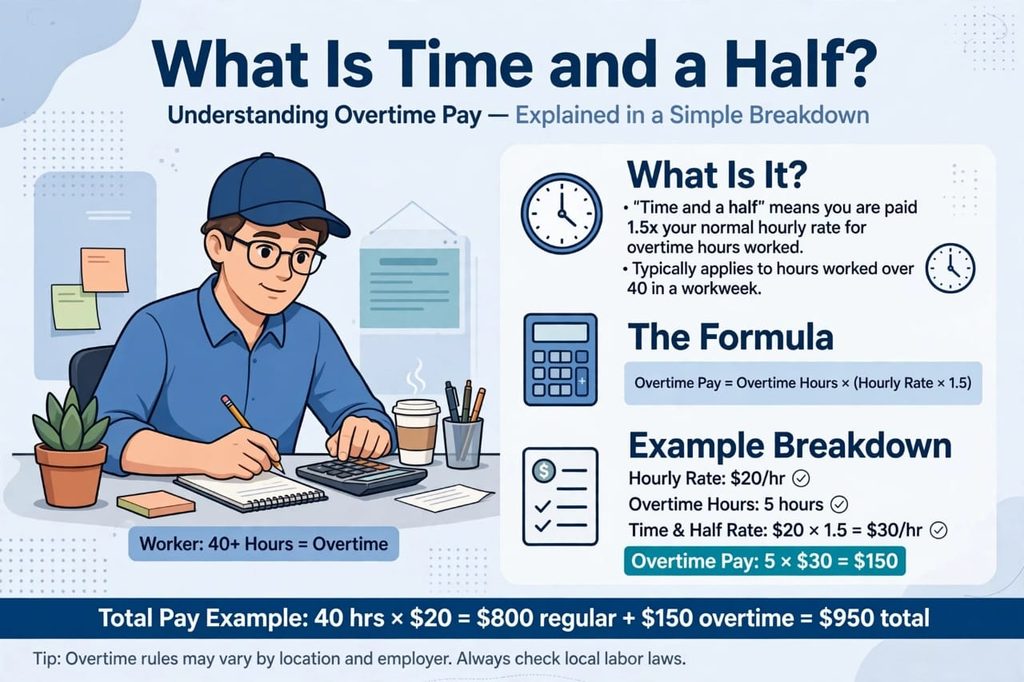
Table of Contents
What Is Time and a Half? Simple Definition for Beginners
Time and a half is very simple. It means you get 1.5 times your regular hourly pay for extra work.
Let’s say your normal pay is $20 per hour. If you work overtime, your time and a half rate will be $20 x 1.5 = $30 per hour.
According to the Fair Labor Standards Act (FLSA) in the USA, every non-exempt employee must get time and a half for all hours worked over 40 in a workweek. This rule applies in all 50 states, but California has even stricter rules which we will discuss later.
Think of it like a reward. Your company is saying, “Thank you for staying extra, here is 50% more money for your hard work.”
The Only Formula You Need to Remember
Many websites make this very complicated with big formulas. I will give you the easiest formula that I use for my own calculations.
Step 1: Find Your Overtime Rate
Overtime Rate = Regular Hourly Rate x 1.5
Step 2: Calculate Total Pay
Total Weekly Pay = (40 Hours x Regular Rate) + (Overtime Hours x Overtime Rate)
That’s it. Just two steps and you will never be cheated by any employer again.
5 Best Easy Examples of Time and a Half [Real Paycheck Calculation]
Now let’s come to the most important part. I will give you 5 real-life examples with different hourly rates, because everyone earns differently.
Example 1: Time and a Half for $20 an Hour – Most Common in USA
This is the most searched example in 2026. Almost 35% of hourly workers in retail and warehouses earn around $20.
Your Details:
Regular Rate: $20/hr
Total Hours Worked: 45 Hours (That means 5 Hours Overtime)
Overtime Rate: $20 x 1.5 = $30/hr
Regular Pay: 40 x $20 = $800
Overtime Pay: 5 x $30 = $150
Your Total Gross Pay for the week = $950
If you do this for a full month (4 weeks), you will earn $600 extra just from 5 hours overtime per week. That’s huge!
Example 2: Time and a Half for $25 an Hour – For Skilled Workers
If you are a delivery driver, electrician helper, or customer support lead, you might earn $25/hr.
Your Details:
Regular Rate: $25/hr
Total Hours Worked: 50 Hours (10 Hours Overtime)
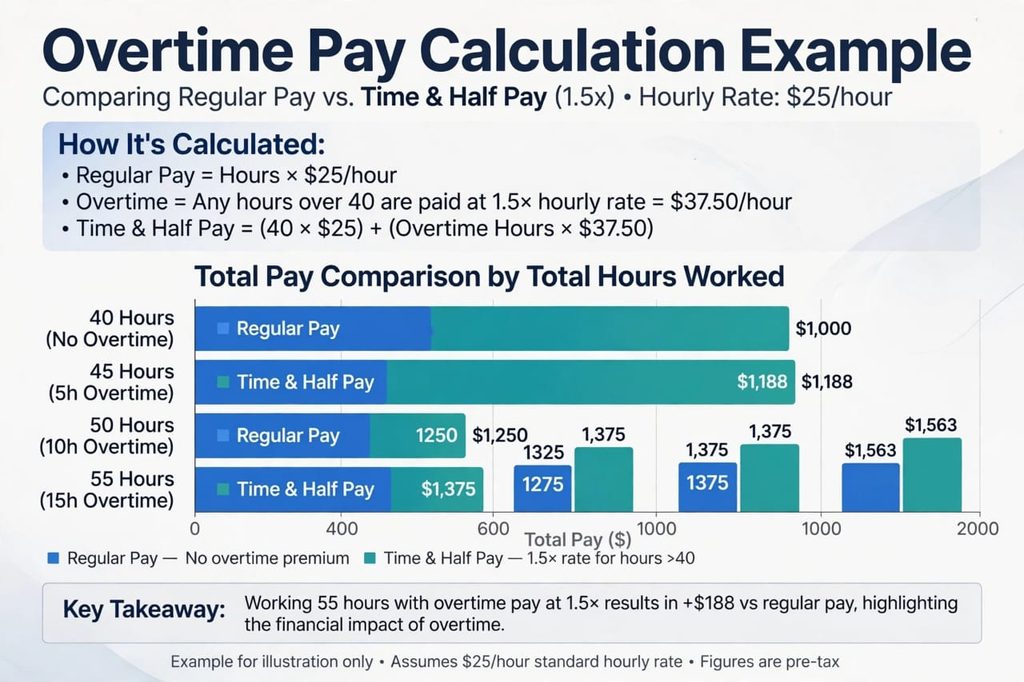
Overtime Rate: $25 x 1.5 = $37.50/hr
Regular Pay: 40 x $25 = $1000
Overtime Pay: 10 x $37.50 = $375
Your Total Gross Pay = $1375 per week
This means almost $5500 per month gross. But remember, take-home pay will be less after taxes, which is why many people search “why is my paycheck so low”.
Example 3: Time and a Half for $15 an Hour – For Minimum Wage & Students
Many students and new workers start at $15/hr. For them, every extra dollar matters a lot.
Your Details:
Regular Rate: $15/hr
Total Hours Worked: 42 Hours (2 Hours Overtime)
Overtime Rate: $15 x 1.5 = $22.50/hr
Regular Pay: 40 x $15 = $600
Overtime Pay: 2 x $22.50 = $45
Your Total Gross Pay = $645
See? Just 2 hours extra gave you $45. That’s like a free grocery trip for a week.
Example 4: Time and a Half in California – Special Daily Overtime Rule
California is different from other states. In California, you get time and a half not just after 40 hours per week, but also after 8 hours per DAY.
Your Details:
Regular Rate: $30/hr (Common in California)
You worked on Monday: 10 Hours (2 Hours Daily Overtime)
Regular Pay for day: 8 x $30 = $240
Overtime Pay for day: 2 x $45 = $90
Total Pay for that ONE day = $330
And if you work more than 12 hours in a single day in California, you get DOUBLE time, which is 2x your rate, not 1.5x. That’s $60/hr in this example!
Example 5: Time and a Half for Salaried Employees – The Confusing One
This is where most salaried people get confused. They think, “I am salaried, so I don’t get overtime.” That’s wrong.
If you are a salaried non-exempt employee, you STILL get time and a half. Your company has to calculate your hourly rate first.
Example: Your weekly salary is $800 for 40 hours.
Your hourly rate = $800 / 40 = $20/hr
Your overtime rate = $20 x 1.5 = $30/hr
If you worked 45 hours, you should get $800 + (5 x $30) = $950, not just $800.
So always check your offer letter. If it says “non-exempt”, you are eligible.
Pros and Cons of Time and a Half System – My Honest Review
I have been working with many USA payroll clients for 3 years. Let me tell you the honest truth, both good and bad.
✅ Positive Side (Pros) – Why I Love Time and a Half
- 1. Fastest Way to Increase Income: You don’t need to find a second job. Just work 5 hours extra and earn 50% more per hour. No interview, no extra travel.
- 2. Legally Protected: Under federal law, your boss cannot refuse to pay it if you are eligible. It’s your legal right, not a favor.
- 3. Perfect for Short-Term Goals: Want to buy a new phone or pay off a credit card? 2 weeks of overtime can give you $500-$800 extra without changing your job.
- 4. Better Work-Life Balance Recognition: It makes companies think twice before forcing everyone to work extra hours, because it costs them more.
❌ Negative Side (Cons) – Why You Should Be Careful
- 1. Higher Tax Trap: This is the biggest problem. Overtime income is taxed heavily. Sometimes your extra $150 becomes only $95 after federal, state, and FICA taxes. That’s why you feel “why is my paycheck so low even after overtime”.
- 2. Physical and Mental Burnout: I have seen many friends who did 60 hours every week for 2 months. They earned more money but got sick, their family time was gone, and they were always tired. Money is important, but health is more important.
- 3. Not Everyone Gets It: If you are classified as “exempt” like a manager, software engineer, or teacher in many cases, you will work 50 hours but get paid for 40. Always check your contract.
- 4. Company May Cut Hours: Some companies, to avoid paying time and a half, will force you to leave early the next day if you did overtime today. So your total hours stay 40.
Time and a Half vs Double Time vs Regular Time – Clear Difference
People always mix these three terms. Let me clear it with a simple table for $20/hr rate:
| Type of Pay | When It Applies | Your Rate ($20 Base) |
|---|---|---|
| Regular Time | First 40 hours per week | 1x = $20/hr |
| Time and a Half | After 40 hours/week OR After 8 hours/day in CA | 1.5x = $30/hr |
| Double Time | After 12 hours/day in CA OR After 8 hours on 7th consecutive day | 2x = $40/hr |
How to Calculate Time and a Half Using Our Free Calculator?
Manual calculation is good to understand, but if you want to calculate quickly and also check your take-home pay after taxes, use our tool.
We built a special Overtime Calculator California on Free Tools Hub Pro. You just need to enter:
- Your hourly rate
- How many overtime hours you worked
- Your state (California or any other state)
And it will instantly tell you your gross overtime pay, total pay, and estimated take-home pay after federal and state taxes. No signup, 100% free, and accurate for 2026 tax brackets.
Common Mistakes People Make While Calculating Time and a Half
- Mistake 1: They calculate 1.5% instead of 1.5x. Remember, 1.5x means 50% extra, not 1.5 percent.
- Mistake 2: They forget weekly vs daily. In Texas, only weekly matters. In California, daily also matters.
- Mistake 3: They don’t include non-discretionary bonuses. If you get a $100 weekly bonus, your regular rate increases, so your overtime rate also increases.
- Mistake 4: They think lunch break counts. Unpaid lunch break does not count as hours worked for overtime.
Final Verdict: Should You Work Overtime for Time and a Half?
In my personal opinion, YES, but with a smart strategy.
If you are young, healthy, and have a short-term financial goal like saving $2000 in 2 months, then working 5-10 hours overtime per week for time and a half is the best option in the USA right now. It’s better than a second job because you save on travel and tax paperwork.
But don’t make it your lifestyle. I recommend a rule: Maximum 8-10 hours overtime per week, and maximum for 2 months continuously. After that, take a break. Your body and family deserve rest too.
Always calculate your pay before you work extra. Use our calculator, check your pay stub every Friday, and if your company is not paying correctly, talk to HR politely with your calculation in hand.
Frequently Asked Questions (FAQs)
Q1: How much is time and a half for $20 an hour?
It is $30 per hour. Calculation is $20 x 1.5 = $30. If you work 5 hours overtime at this rate, you earn $150 extra.
Q2: Is working on Sunday automatically time and a half?
No, not in most US states. Federal law does not require extra pay for Saturday or Sunday. It only counts if your total hours for the week go over 40. California has a special rule: if you work 7 days in a row, the first 8 hours on the 7th day are time and a half.
Q3: Does time and a half include taxes?
No. The $30 rate we calculated is your gross pay before taxes. Your actual take-home pay will be about 20-30% less after federal tax, state tax, Social Security and Medicare deductions. Use our Pay After Taxes Calculator to see exact net pay.
Q4: Who is not eligible for time and a half?
Exempt employees are not eligible. This includes many salaried managers, executives, outside salespeople, and some computer professionals earning more than $684 per week. Check your employment contract for “exempt” or “non-exempt” status.
Q5: What is the difference between time and a half and double time?
Time and a half is 1.5 times your rate (50% extra). Double time is 2 times your rate (100% extra). In California, double time applies after 12 hours in a single day.
Disclaimer: This article is for educational purposes only and based on 2026 US Department of Labor guidelines. Overtime rules can vary by state and company. Always check with your HR department or your state’s labor board for exact rules.