You worked hard all week. You checked your hours, you did the math in your head, and you expected a nice, big number in your bank account.
Then payday comes. You open your bank app, and the number is much smaller than you thought. You feel confused, maybe even a little cheated.
If this has ever happened to you, you are not alone. Almost every worker in America feels this way when they look at their first few pay stubs.
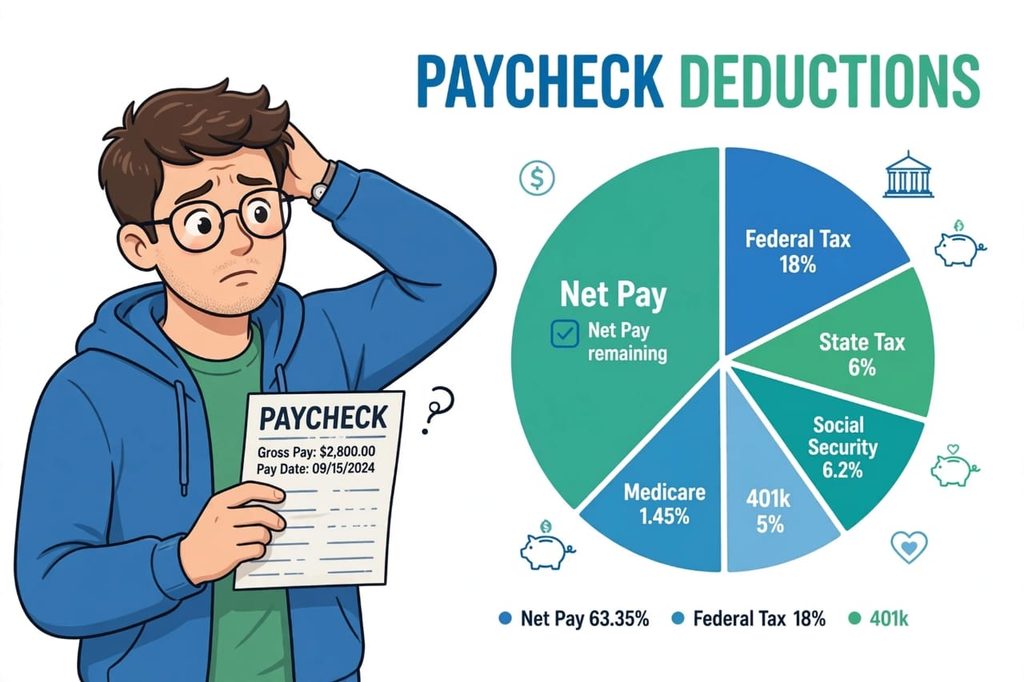
I remember my own first job in the US. I was supposed to earn $2,800. I had already planned how I would spend it – rent, groceries, a little bit for myself. But when the money arrived, it was only $2,150. I thought my employer had made a mistake. I was angry. I almost went to HR to complain.
But there was no mistake. The missing $650 was in taxes and other deductions that I had never heard of before.
That is exactly why you need to learn how to read your pay stub. Your pay stub is not just a piece of paper. It is the full story of where your money goes. Once you understand it, you will never feel confused or scared on payday again.
In this guide, we will explain every single line on your pay stub in simple, human language. No confusing tax jargon. Just real examples with real numbers for 2026.
What Is a Pay Stub and Why Does It Matter?
A pay stub, also called a payslip or paycheck stub, is a document your employer gives you every time you get paid. If you get direct deposit, you will usually find it in your employee portal, in an app like ADP, Paychex, or Workday, or in your email.
Your pay stub shows three important things:
- How much you earned in total
- How much was taken out in taxes and deductions
- How much you actually take home
Why should you care? Because mistakes happen more often than you think. A wrong tax withholding, a wrong number of hours, or a missing overtime payment can cost you hundreds of dollars.
When you know how to read your pay stub, you can catch those mistakes in 2 minutes. You also learn how to plan your budget better, because you will know exactly what your real take-home pay is, not just your salary on paper.
The Good News and The Bad News About Your Paycheck
Let’s be honest. There are two sides to every pay stub.
The positive side is that many deductions are actually working for you. Social Security and Medicare are building your future retirement and healthcare. Your 401(k) is growing your savings. Your health insurance is protecting you if you get sick. These are not wasted money. They are investments in your future.
The negative side is that taxes in the USA are complicated and sometimes feel unfair. You can work overtime and still feel like you didn’t earn much more, because a bigger chunk goes to taxes. If you live in a high-tax state like California or New York, your take-home pay can be 25% to 30% less than your gross pay. That is a painful reality for many low and middle-income workers.
The goal of this article is not to make you love taxes. The goal is to make you understand them, so you can keep as much of your money as legally possible.
The Main Sections of Your Pay Stub
Most pay stubs in the USA look different, but they all have the same 5 main sections. Let’s go through them one by one.
1. Employee and Employer Information
At the top of your pay stub, you will see your name, your employee ID, and sometimes the last 4 digits of your Social Security Number. You will also see your employer’s name and address.
Below that, you will see the Pay Period and Pay Date.
Pay Period: This is the dates you worked for. For example, March 1 to March 15.
Pay Date: This is the day the money actually hits your bank account.
Always check this section first. If your pay period is wrong, your hours will be wrong too.
2. Gross Pay – The Big Number That Is Not Yours Yet
Gross Pay is the total amount you earned before anything is taken out.
If you are paid hourly, it is calculated like this:
Hourly Rate x Hours Worked = Gross Pay
Example: $22 per hour x 80 hours = $1,760 Gross Pay
If you are salaried, your gross pay is your annual salary divided by the number of pay periods. If you earn $52,000 per year and get paid every two weeks, your gross pay is $2,000.
Gross pay also includes overtime pay, bonuses, commissions, and tips if you get them. It is the biggest number on your stub, but sadly, it is not the number you get to keep.
3. Federal Income Tax – The Biggest Deduction for Most People
This is usually the largest deduction on your pay stub. The federal government takes this tax based on how much you earn and what you filled out on your Form W-4.
How much is it? In 2026, federal tax brackets for a single filer start at 10% and go up to 37% for very high earners. Most average workers fall in the 12% to 22% bracket.
The important thing to understand is that your employer does not decide this amount randomly. They use IRS withholding tables and your W-4 form to estimate it.
Positive point: If too much is withheld, you will get a tax refund when you file your taxes in April. Many people love getting that refund.
Negative point: If too little is withheld, you might have to pay extra money at tax time. That is a painful surprise that many people face.
Pro Tip: If you got a huge refund last year (more than $1,500), you are probably having too much withheld from each paycheck. You are giving the government a free loan. You can adjust your W-4 to get more money in each paycheck instead.
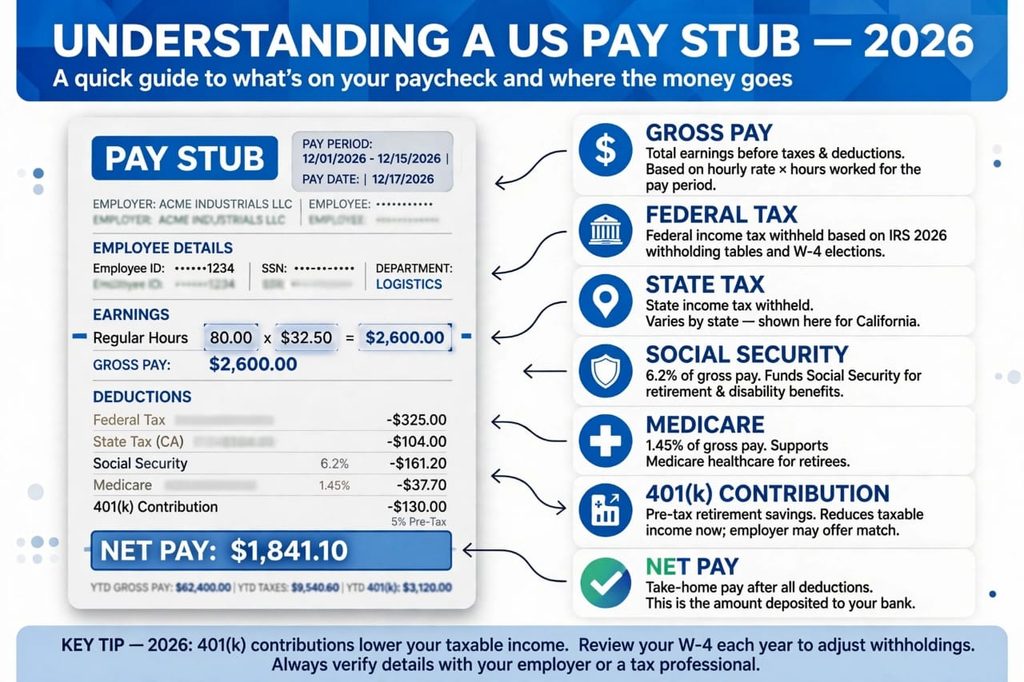
Table of Contents
4. State and Local Income Tax – It Depends Where You Live
After federal tax, you will see State Tax. This is where it gets very unfair for some people.
If you live in Texas, Florida, Nevada, Wyoming, Washington, South Dakota, or Alaska, you pay $0 in state income tax. That is a huge advantage. Your paycheck will be much bigger.
If you live in California, New York, or New Jersey, you could pay 5% to 10% extra in state tax. On a $3,000 paycheck, that is $150 to $300 gone just for your state.
Some cities also have local tax. For example, New York City has its own city tax on top of state tax.
If you recently moved to a new state, always check this line. Many people move from California to Texas and are shocked – in a good way – at how much bigger their paycheck becomes.
5. FICA Taxes – Social Security and Medicare
You will see two lines called FICA, which stands for Federal Insurance Contributions Act. You cannot avoid these. Every worker in the USA pays them.
Social Security: 6.2% of your gross pay
Your employer also pays another 6.2%. This money goes to fund retirement benefits for older Americans, and it will fund your own retirement one day. In 2026, you only pay this on the first $176,100 of your income. After that, you stop paying it for the year.
Medicare: 1.45% of your gross pay
Your employer also pays 1.45%. This funds healthcare for people over 65. Unlike Social Security, there is no limit. You pay it on all your income. If you earn over $200,000, you pay an extra 0.9%.
Positive point: These taxes guarantee you will have some income and healthcare when you retire.
Negative point: You feel it right now. For a young worker earning $2,500, that is $191.25 gone every paycheck for benefits you won’t use for 40 years. It can feel frustrating, but it is the law.
6. Pre-Tax Deductions – The Deductions That Actually Help You
Not all deductions are bad. Pre-tax deductions are taken out BEFORE your taxes are calculated, which means they actually lower your taxes.
The most common ones are:
401(k) Retirement Plan: If you put 5% of your pay into a 401(k), your taxable income goes down. That means you pay less in federal tax. And many employers match it. If your employer matches 4%, that is free money. Never leave that free money on the table.
Health Insurance Premium: Your share of medical, dental, and vision insurance. This is also pre-tax in most jobs.
HSA / FSA: Health Savings Account or Flexible Spending Account. You put money in tax-free to pay for medical expenses.
Example: If your gross pay is $3,000 and you put $150 into your 401(k), the government only taxes you on $2,850. You saved money on taxes AND saved for retirement. That is a win-win.
7. Post-Tax Deductions – Taken After Taxes
These are taken out after taxes, so they do not lower your tax bill. Common examples include Roth 401(k), union dues, wage garnishments, or charitable donations.
Always check these lines carefully. If you see a deduction you do not recognize, ask HR immediately.
8. Net Pay – The Number That Actually Matters
At the bottom of your pay stub, you will see Net Pay, also called Take-Home Pay. This is the money that actually goes into your bank account.
Formula:
Gross Pay – All Taxes – All Deductions = Net Pay
Example for a real worker in California in 2026:
Gross Pay: $3,200.00
Federal Tax: -$352.00
State Tax (CA): -$128.00
Social Security: -$198.40
Medicare: -$46.40
401(k) 5%: -$160.00
Health Insurance: -$120.00
Net Pay: $2,195.20
In this example, the worker lost $1,004.80, which is 31.4% of his pay. This is normal in California. In Texas, the same worker would take home around $2,323 because there is no state tax.
That is why two people with the same salary can have very different lives depending on where they live.
5 Common Pay Stub Mistakes You Must Check Every Month
- Wrong Hours: Especially if you are hourly, compare your pay stub hours with your own notes. Overtime should be paid at 1.5x your normal rate.
- Wrong Tax Withholding: If your federal tax suddenly doubles, your W-4 might be wrong.
- Missing Bonus or Commission: Bonuses are often taxed at a higher rate (22% federal). But they should still be there.
- Double Health Insurance Deduction: Sometimes when you change plans, HR deducts twice by mistake.
- Wrong State: If you moved and work remotely, your employer might still be withholding tax for your old state.
If you find a mistake, don’t wait. Email HR with a screenshot of your pay stub the same day. Most mistakes can be fixed in the next pay cycle if you report them early.
How to Increase Your Take-Home Pay Legally
You cannot avoid taxes, but you can be smart about them.
- Adjust Your W-4: Use the free IRS Tax Withholding Estimator online once a year. If you are over-withholding, fixing your W-4 can add $100 to $200 to each paycheck.
- Contribute to Your 401(k) Up to the Match: At least contribute enough to get the full employer match. It is 100% free money.
- Use an HSA if Available: If you are young and healthy, an HSA is one of the best tax tools in America. It is triple tax-free.
- Check Your State: If you have the option to work remotely from a no-tax state, it can save you thousands per year.
- Use Our Calculator: Before you make any changes, use our Paycheck Calculator 2026 to see exactly how much your take-home pay will change. It will show you your federal, state, FICA, and net pay in seconds.
To check your exact take-home pay after all these deductions, use our Paycheck Calculator 2026 to calculate your take-home pay after taxes in USA.
Final Thoughts: Don’t Fear Your Pay Stub
Learning to read your pay stub is like learning to read the dashboard of your car. At first, all the lights and numbers look scary. But once you understand them, you feel in control.
Now that you know how to read your pay stub, you can check every paycheck with confidence.
Your pay stub is not your enemy. It is your tool. It tells you where your money is going, what you are building for the future, and where you might be losing money unnecessarily.
So next payday, don’t just check your bank balance. Open your pay stub. Spend 5 minutes reading it line by line using this guide. Check your gross pay, your taxes, your 401(k), and your net pay.
If you understand it, you can plan better, save more, and avoid surprises at tax time. And that is the first real step to financial freedom in America.
Want to know what your next paycheck will actually be? Try our free Paycheck Calculator 2026 now and see your real take-home pay in less than 30 seconds.