Pregnancy test after missed period is the most common question every woman asks. If your period is late, you are probably wondering how many days you should wait before testing. In this guide, you will learn the most accurate day to take a pregnancy test after missed period, how to avoid a false negative, and you can use our free calculator below to find your exact test date.
If your period is late, your mind starts racing. You check the calendar again and again. You Google every little symptom. You feel tired, your breasts feel sore, you feel a little nauseous, and one question keeps coming back: Am I pregnant?
I have seen this moment a thousand times in my clinic. A young woman sits in front of me, nervous, holding her phone, and she asks me the exact same question you are asking right now: Doctor, how many days after my missed period should I take a pregnancy test?
Take a deep breath. You are not alone in this. And the good news is, the answer is simple if you understand how your body works.
In this guide, I will explain it to you exactly like I explain it to my patients in the USA. No confusing medical language. Just clear, honest, doctor-approved advice. By the end, you will know exactly when to test, how to test correctly, what a positive or negative result really means, and when you need to see a doctor.
🤰 Pregnancy Test Calculator
Find your most accurate day to take a test
Free Tool by FreeToolsHubPro.com

Table of Contents
The Short Answer – If You Are In A Hurry
If you do not have time to read the full article, here is the short answer:
Wait at least 1 day after your missed period to take a home pregnancy test.
For the most accurate result, wait 7 days after your missed period.
Why? Because your body needs time to make enough hCG hormone. hCG is the pregnancy hormone that home tests look for. If you test too early, there may not be enough hCG in your urine yet, and you can get a false negative even if you are actually pregnant.
If you test 1 day after your missed period, most good tests like First Response and Clearblue are about 99% accurate. If you wait 7 days, they are almost perfect.
So my advice as a doctor is always the same: If you can wait, wait 1 week. It will save you stress, money, and confusion.
What Is A Missed Period Really?
A missed period does not always mean you are pregnant. Let us be honest about that first.
A normal menstrual cycle in the USA is between 21 to 35 days, with an average of 28 days. But your cycle is not a clock. Stress, travel, lack of sleep, weight change, new medication, PCOS, thyroid problems, or even a bad cold can delay your period by 2-3 days.
In my practice, I tell women: If your period is 1-2 days late, do not panic. If it is 7 days late and you have been sexually active, then it is time to test.
To know if your period is truly missed, you need to know your own cycle. If your period usually comes on the 15th of every month, and today is the 17th and nothing has happened, that is 2 days late. That is your missed period count.
If you have irregular periods, it is harder. In that case, count from your last period and your longest cycle. For example, if your cycles are 30 to 36 days, wait until day 37 to test.
How Does A Pregnancy Test Actually Work?
This part is important because once you understand it, you will never test too early again.
When an egg is fertilized, it travels to the uterus and implants in the uterine wall. This is called implantation. It usually happens 6 to 10 days after ovulation.
After implantation, your body starts making hCG – human chorionic gonadotropin. This is the hormone that tells your body, Hey, we are pregnant, keep the pregnancy going.
A home pregnancy test does not look for a baby. It looks for hCG in your urine.
In the beginning, hCG levels are very low. They double every 48 to 72 hours. So on day 1 after implantation, you might have only 5 mIU/mL. Two days later, 10. Two days later, 20. And so on.
Most home tests in the USA need at least 25 mIU/mL to show a positive line. That is why timing is everything. If you test on the day you think your period should come, you may only have 15 mIU/mL, and the test will say negative, even though you are pregnant. This is called a false negative, and it is the most common mistake I see.
This is also why doctors tell you to use first morning urine. Your first urine of the day is the most concentrated. It has the highest amount of hCG. If you test in the afternoon after drinking 3 bottles of water, your urine is diluted and the test might miss it.
How Many Days After Missed Period Should You Take A Test? The Full Timeline
Let us break this down day by day, so you know exactly what to expect.
Day 0 – The Day Your Period Was Due
You are anxious. You want to know now. Can you test today? Yes, you can, but you should know the accuracy is only about 80% to 85%. Many early detection tests claim they can detect pregnancy 6 days before your missed period. They can, sometimes. But for most women, this is too early.
If you get a positive on Day 0, trust it. A positive is almost always a true positive. False positives are very rare. If you get a negative, do NOT trust it fully. Wait and retest.
1 Day After Missed Period
This is the first good day to test. Most major brands in the USA – Clearblue, First Response Early Result, EPT – claim 99% accuracy from this day onward if you follow instructions correctly.
If your period is 1 day late and you test with first morning urine, and it says negative, there is still about a 10-15% chance it is too early. So keep the test box. You may need it again.
3 Days After Missed Period
By now, your hCG levels have doubled at least once. Accuracy jumps to about 98-99%. If you are pregnant, most women will get a clear positive by day 3.
If you still get a negative but your period has not come, do not lose hope yet. Some women implant late. Wait 2 more days.
7 Days After Missed Period – The Doctor’s Gold Standard
This is what I recommend to almost all my patients. Wait 7 days after your missed period.
By day 7, if you are pregnant, your hCG is high enough that even the cheapest dollar store test from Walmart or Dollar Tree in the USA will catch it. You do not need an expensive test.
If you test on day 7 and it is negative, and your period still has not come, then it is very likely you are not pregnant, and something else is delaying your period. At this point, you should retest in 3 days one last time, and if still negative, call your doctor.
14 Days After Missed Period
If your period is 2 weeks late and all home tests are negative, you need to see a doctor. Do not keep testing at home. You need a blood test. A blood hCG test can detect pregnancy much earlier and more accurately than urine. It can also tell your doctor if there is another issue like thyroid, PCOS, or stress-related delay.
What Does A Positive Result Mean?
Let us talk about the moment you see those two lines.
A positive result means the test found hCG in your urine. Even a very faint second line is a positive. I repeat this in my clinic every single day because so many women get confused. A faint line is NOT a maybe. It is a positive.
What does a faint line mean? It means your hCG is still low, but it is there. It usually means you are very early in pregnancy, maybe 4 weeks pregnant.
What should you do after a positive?
- Take a deep breath. Do not panic.
- Take another test the next morning to confirm. Use first morning urine again.
- Start taking folic acid if you are not already. In the USA, doctors recommend 400 to 800 mcg of folic acid daily in early pregnancy.
- Call your OB-GYN or your local clinic to book your first prenatal visit. In the USA, the first visit is usually at 8 weeks.
- Do not drink alcohol, do not smoke, and avoid raw fish and unpasteurized cheese until you talk to your doctor.
A positive home test is right 99% of the time. The only times it can be wrong are if you are taking fertility medication with hCG, you had a very recent miscarriage, or you read the test after 10 minutes and saw an evaporation line. Always read the test within the time mentioned on the box, usually 3 to 5 minutes.
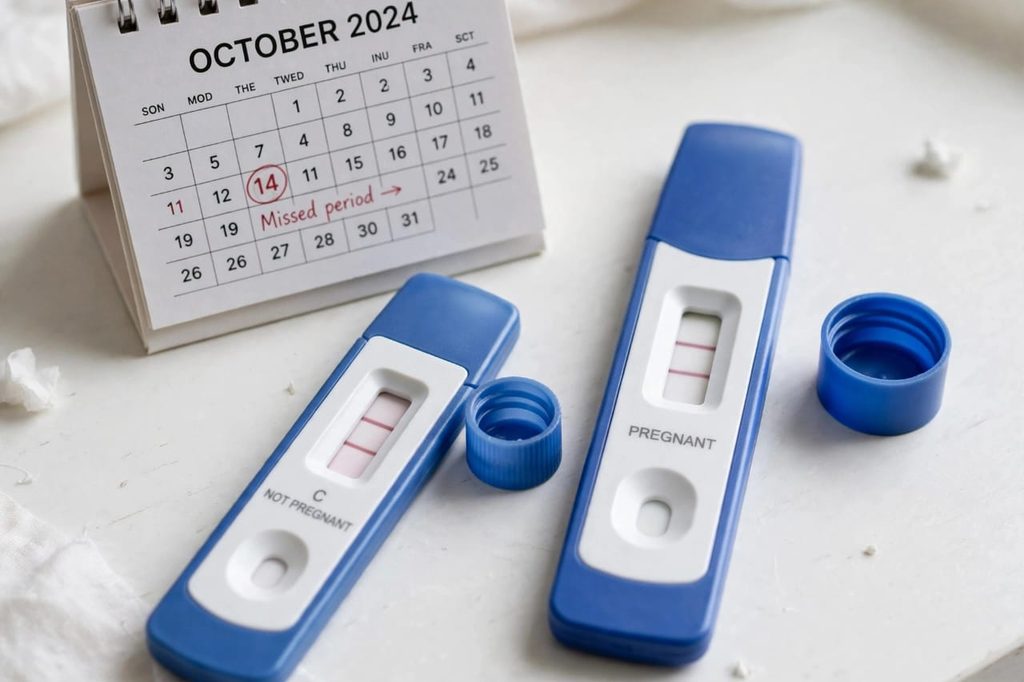
What Does A Negative Result Mean?
A negative result can be more confusing than a positive one, because a negative does not always mean not pregnant.
There are two types of negative results:
True Negative: You are not pregnant. Your period is late because of stress, illness, weight change, or hormonal imbalance.
False Negative: You ARE pregnant, but you tested too early. Your hCG was too low for the test to find it. This is the most common reason women say, My test was negative but I was actually pregnant.
How do you know which one you have?
If you tested 1 day after your missed period and got a negative, wait 48 hours and test again. hCG doubles every 2 days. In 48 hours, a false negative often turns into a clear positive.
If you tested 7 days after your missed period and got a negative, and you used first morning urine and followed instructions correctly, it is most likely a true negative.
One mistake I see women make is drinking too much water before testing. If your urine is very light yellow or almost clear, it is too diluted. Wait for morning.
Why Your Period Might Be Late Even If You Are Not Pregnant
I know this is hard to hear, but a late period does not automatically mean pregnancy. In my clinic, about 40% of women who come in for a late period are not pregnant.
Here are the most common reasons in the USA:
1. Stress: Final exams, a new job, moving, a breakup, or even worrying about being pregnant can delay ovulation. Your brain and your ovaries are connected.
2. PCOS – Polycystic Ovary Syndrome: This is very common in the USA. It causes irregular periods, acne, and extra hair growth. If your periods are always irregular, ask your doctor to check for PCOS.
3. Thyroid Problems: Both low and high thyroid can mess up your cycle.
4. Birth Control: If you just stopped the pill, or you just started a new birth control, your cycle can take 2-3 months to become regular again. The morning-after pill can also delay your period by up to 7 days.
5. Weight Change: Losing a lot of weight quickly, or gaining a lot, or exercising too hard, can stop ovulation.
6. Breastfeeding: If you are breastfeeding, your periods can be irregular for months.
7. Perimenopause: If you are over 40, your cycles can become irregular as you approach menopause.
So, if your test is negative and your period is still late, do not just keep testing. Think about what else changed in your life this month.
How To Take A Pregnancy Test Correctly – Step By Step Doctor’s Guide
Many women get wrong results not because the test is bad, but because they did not use it correctly. Here is exactly how I tell my patients to do it in the USA:
Step 1: Buy a good test. In the USA, First Response Early Result is the most sensitive. Clearblue Digital is best if you want it to say Pregnant or Not Pregnant in words, so you do not have to guess about lines. Dollar store tests also work well AFTER your missed period, but not before.
Step 2: Test in the morning. Use your first urine of the day. Do not drink a big glass of water before.
Step 3: Read the instructions. Every test is a little different. Some need 5 seconds under urine stream, some need 10 seconds. Some need you to dip in a cup. Follow the box.
Step 4: Set a timer. Do not stare at it for 10 minutes. Read it at exactly 3 minutes, or whatever time the box says. If you read it after 10 minutes, you might see an evaporation line that looks like a faint positive but is not.
Step 5: If negative and period still missing, retest after 48 to 72 hours. Use a new test.
Step 6: If positive, call your doctor. Do not wait for weeks.
Can You Test Before Your Missed Period?
Yes, you can, but should you?
In the USA, many brands sell Early Detection tests that claim to work 6 days before your missed period. The truth is, they only work for about 50-60% of women that early.
Here is what happens when you test early: You get a negative, you feel relieved, but then your period does not come, and you get anxious again. Or worse, you get a very faint positive, and then you get your period a few days later. That is called a chemical pregnancy – a very early miscarriage that happens before most women even know they were pregnant. It is very common, about 1 in 4 pregnancies, but it causes a lot of emotional pain when you find out too early.
My honest doctor advice: If you can handle waiting, wait until your missed period. Your heart will thank you.
If you cannot wait, and you absolutely must test early, test 3 days before your missed period at the earliest, and use First Response Early Result with first morning urine. And be ready to retest.
When Should You See A Doctor Immediately?
Call your doctor or go to urgent care if you have any of these symptoms, even if your test is negative:
- Severe stomach pain on one side
- Heavy bleeding, soaking a pad in one hour
- Fever over 100.4 F
- Dizziness or fainting
- Shoulder pain with a missed period
These can be signs of an ectopic pregnancy, which is when the pregnancy grows outside the uterus. It is rare, but it is an emergency. Do not wait.
Also see your doctor if your period is more than 3 months late and all tests are negative, or if you miss periods 3 times in a row. You need a blood test and a checkup.

Final Doctor Advice
I know waiting is the hardest part. Those days between your missed period and your test feel like years. You are checking every symptom on Google, you are asking your friends, you are scared and hopeful at the same time.
Remember this: Your body is not a machine. One late period does not define you. Testing at the right time is an act of kindness to yourself. It gives you a clear answer, not a confusing maybe.
So here is my simple rule for you to remember:
1 Day Late = You CAN Test
7 Days Late = You SHOULD Test For Best Accuracy
14 Days Late + Negative = See Your Doctor
Use our calculator above to find your exact best test day based on your last period. Enter your date, and it will tell you when to test for the most accurate result.
And whatever your result is, positive or negative, you will get through this. If you are pregnant, we are here to help you through a healthy pregnancy. If you are not, and you want to be, we can help you plan for next month. If you are not and you do not want to be, you have options, and you can talk to your doctor without judgment.
Take care of yourself. You deserve clear answers and calm support.
Frequently Asked Questions (FAQs)
Q1: Can I get a positive test 2 days after missed period?
Yes. If you are pregnant, most women will get a positive by 2-3 days after their missed period, especially with first morning urine. Accuracy is about 98% at this point.
Q2: I got a negative test but my period is 10 days late. Am I pregnant?
It is unlikely, but possible. If you tested with first morning urine and followed instructions, a negative at 10 days late is usually a true negative. Retest once more in 48 hours, and if still negative, see your doctor for a blood test.
Q3: Can stress delay my period by a week?
Yes. High stress can delay ovulation by several days, which delays your period by a week or more. This is very common in college students and women starting a new job in the USA.
Q4: What is the best time of day to take a pregnancy test?
Early morning, with your first urine of the day. That urine has the highest hCG concentration. If you must test later, try to hold your urine for at least 4 hours and avoid drinking too much water.
Q5: Can a pregnancy test be wrong?
Yes, but rarely. False negatives are common if you test too early. False positives are very rare and usually happen due to fertility drugs, recent miscarriage, or reading the test too late after 10 minutes.
Q6: I see a very faint line. Am I pregnant?
Yes, a faint line is still a positive. It means hCG was detected, but levels are still low. Test again in 48 hours with first morning urine. The line should get darker.
Q7: How soon after sex can I take a pregnancy test?
You need to wait at least 10-14 days after sex, because implantation takes 6-10 days, and then hCG needs time to rise. Testing 3 days after sex will always be negative, even if you are pregnant. It is better to wait until your missed period.
Q8: Do cheap dollar store pregnancy tests work in the USA?
Yes. After your missed period, dollar store tests are just as accurate as expensive ones. Before your missed period, they are less sensitive, so use First Response Early Result if you want to test early.
Q9: My period is irregular. When should I test?
If your periods are irregular, test 36 days after your last period started, or 21 days after unprotected sex, whichever comes first. If negative and still no period, retest in 1 week.
Q10: Can I take a pregnancy test while on birth control?
Yes. Birth control pills, IUD, implant, or shot do not affect the test result. If you are pregnant while on birth control, the test will still show positive. Take the test if your period is late.
Disclaimer: This article is for educational purposes only and is not a substitute for medical advice. Always consult your doctor or OB-GYN in the USA for personal medical decisions.