You waited for two weeks. You worked hard every single day. You were counting the days for your first payday. And then finally, the money comes in, and you look at your bank account and think, this can’t be right. Where did half of my money go?
If you are asking yourself, why is my first paycheck so low, you are not alone. Almost every person in America feels the same shock on their first paycheck. It feels like you were promised one amount, but you got something totally different.
The good news is, in most cases, nothing is wrong. Your company did not cheat you. Your first paycheck is almost always lower than you expect because of taxes, deductions, timing, and a few small mistakes that new employees make. Once you understand how it works, you will never be shocked again.
In this guide, we will explain in simple words why your first paycheck is so low, what was cut from it, and how you can fix it for your next paycheck.
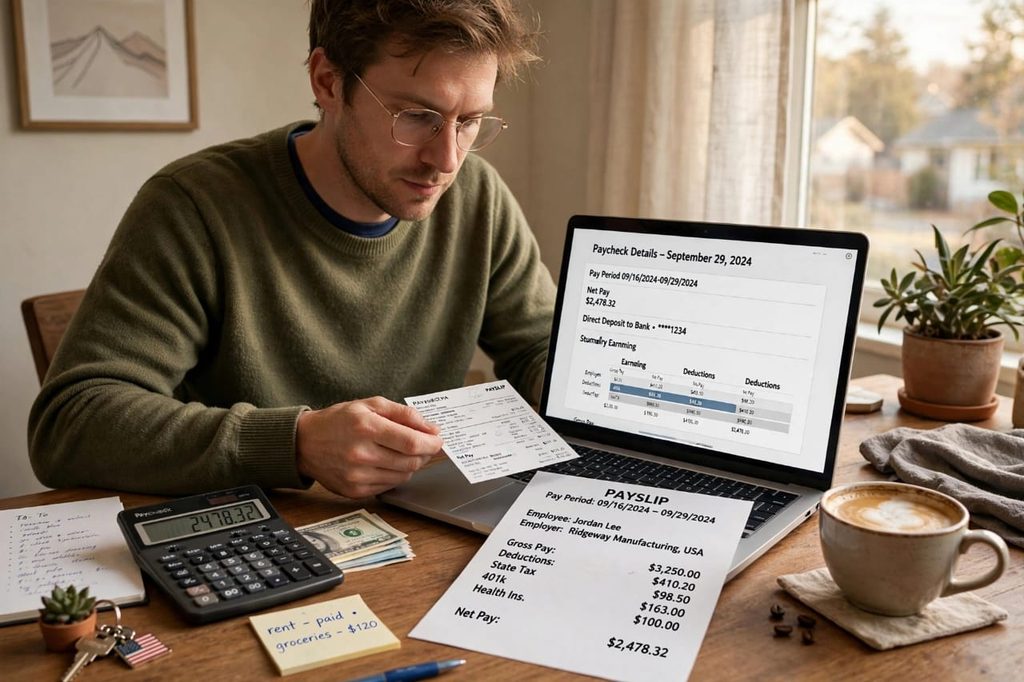
Table of Contents
Why Is My First Paycheck So Low? The Short Answer
Your first paycheck is low because your gross pay is not your take-home pay. Gross pay is the amount your company says you will earn. Net pay is the amount you actually get after everything is taken out.
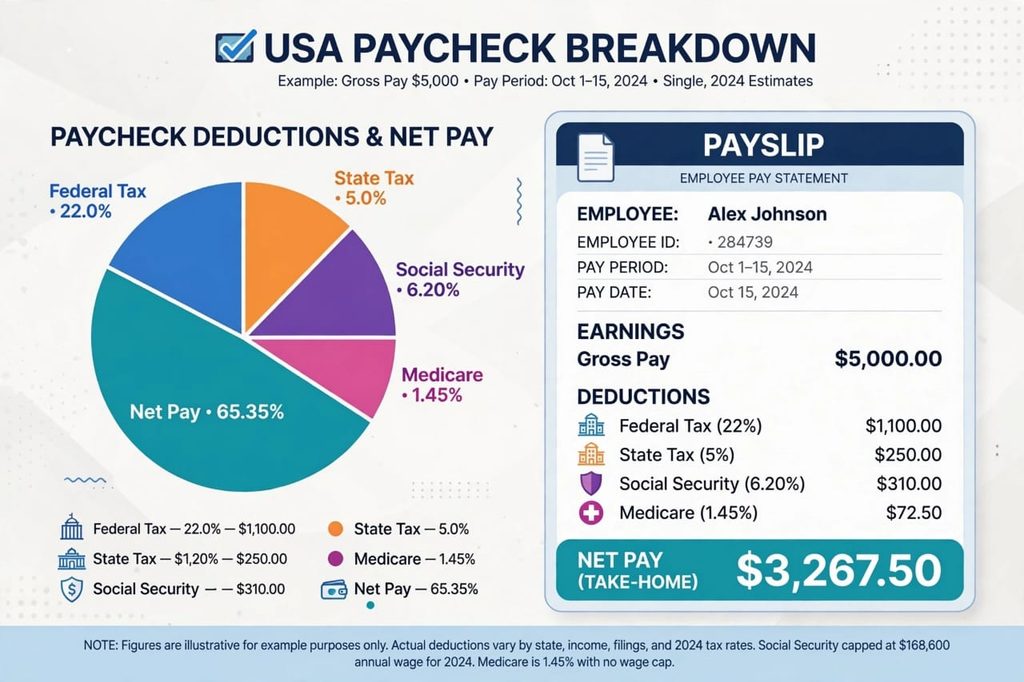
For example, if your salary is $3,000 per month, you will not get $3,000 in your account. The government takes federal tax, state tax, Social Security, and Medicare. Your company may also take money for health insurance, retirement, and other benefits. What is left after all these cuts is your real paycheck.
Most new workers only look at the gross pay in their offer letter. They forget about the deductions. That is why the first paycheck feels like a big surprise.
1. Taxes Take The Biggest Bite From Your First Paycheck
If you want to check your pay yourself, try our Paycheck Calculator.
Taxes are the number one reason your first paycheck looks small. In the USA, your employer has to take taxes out before they pay you. You cannot avoid this.
Federal Income Tax
This is the tax you pay to the US government. How much is taken depends on how much you earn and what you wrote on your W-4 form. If you are single and earn a good salary, federal tax alone can take 10% to 22% of your pay.
Many new employees fill their W-4 wrong. If you put zero allowances or you did not claim correctly, more tax will be taken. That does not mean you lost that money forever. You may get some of it back as a tax refund next year, but right now, your paycheck will look low.
State Income Tax
If you live in states like California, New York, or Illinois, you also pay state income tax. This can be another 4% to 10% of your pay.
But if you live in Texas, Florida, Nevada, Washington, Wyoming, South Dakota, or Alaska, there is no state income tax. That is why two people with the same salary in different states get different paychecks. If your friend in Texas gets more than you in California, this is the reason.
FICA Tax – Social Security and Medicare
FICA is on every paycheck. It is 7.65% of your pay. It is divided into two parts:
- Social Security Tax – 6.2% of your pay
- Medicare Tax – 1.45% of your pay
Your employer pays the other half, but your half is still taken from your paycheck. You cannot opt out of this. Even if you are 18 years old and just started your first job, you still have to pay it.
When you add federal tax, state tax, and FICA together, it is very normal for 25% to 35% of your first paycheck to be gone before you even see it. 2. You Did Not Work A Full Pay Period
This is the most common reason for a very low first paycheck, and most people do not know about it.
Companies do not pay you from the day you join. They pay in pay periods. For example, if the pay period is from 1st to 15th, and you joined on 10th, you will only get paid for 5 days, not 15 days.
So if you expected a full two weeks of pay, but you only worked 5 days in that period, your first paycheck will be very small. Your second paycheck will be normal because then you will have worked the full period.
Always check your start date and your pay period dates on your pay stub. This small timing difference confuses thousands of new workers every month.
Pay Period vs Pay Date Confusion
There is also a difference between pay period and pay date. The pay period is when you worked. The pay date is when you get paid. Most companies pay you one week after the pay period ends. So your first paycheck might be delayed by a week, and when it comes, it only covers a few days. That is completely normal.
3. Health Insurance And Benefits Deductions
When you joined, HR probably asked you to choose health insurance, dental insurance, vision insurance, and retirement plans. Those choices look free on paper, but they are not free.
Health insurance alone can take $100 to $400 per month from your paycheck. If you chose a family plan, it can be even more. Dental and vision are smaller, maybe $20 to $50, but they still add up.
Retirement – 401(k) Deduction
Many companies automatically put you in a 401(k) retirement plan. They may take 3% to 6% of your pay and put it into your retirement account. This is actually good for your future, and many companies match your money, which is like free money. But it makes your first paycheck look smaller right now.
If you did not want this, you can log in to your benefits portal and change or stop it. But think twice, because the company match is a big benefit you should not waste.
4. Your W-4 Form Was Filled Wrong
The W-4 form decides how much federal tax your employer will take. If you fill it wrong, you will either pay too much tax now, or you will owe tax later.
Many first-time workers make these mistakes:
- They leave Step 2 blank even though they have two jobs.
- They do not claim their dependents correctly.
- They write extra withholding because someone told them to.
- They use an old W-4 from a previous job.
If too much tax is taken, your paycheck will be low. You can fix this anytime. Ask HR for a new W-4, fill it carefully, and submit it. Your next paycheck will improve. You can also use the IRS Tax Withholding Estimator online for free to check the correct amount.
5. Other Hidden Deductions You Missed
Sometimes there are small deductions that you did not notice in your offer letter. Check your pay stub for these:
Uniform, Training, or Equipment Fees
Some jobs deduct money for uniform, safety shoes, or training in the first paycheck. This is legal in many states if you agreed to it. Ask HR if there is any one-time deduction.
Wage Garnishment or Child Support
If you have a court order, loan repayment, or child support, that money is taken directly from your paycheck before you get it. This can make a huge difference.
Union Dues or Parking
If you joined a union, union dues will be cut. If your company charges for parking, that will also be cut. These are small, but when added together, they reduce your pay.
How To Read Your First Pay Stub And Find Where Money Went
Do not just look at the final amount. Open your pay stub and check these 5 things:
- Gross Pay: Total money you earned before cuts.
- Federal Tax: Money taken for federal government.
- State Tax: Money taken for your state.
- FICA: Social Security + Medicare.
- Net Pay: Money you actually received.
If you subtract Net Pay from Gross Pay, you will see exactly how much was taken. In most cases, the numbers will be correct. If something looks very wrong, like a deduction you never agreed to, take a screenshot and show it to HR or payroll.
Is My First Paycheck Low Because My Employer Made A Mistake?
Sometimes yes, mistakes do happen. Payroll mistakes are more common than you think, especially for new employees. Check for these errors:
- Your hourly rate is wrong in the system
- Your hours are missing or counted less
- You were paid at the wrong tax rate
- Overtime was not added
- Your direct deposit was split
If you find a mistake, do not wait. Email payroll immediately with your pay stub and your hours. Most companies fix it in the next pay cycle and pay you the missing amount.
But before you complain, always check your pay stub first. In 90% of cases, there is no mistake, it is just taxes and timing.
How To Make Your Next Paycheck Bigger
You cannot avoid taxes completely, but you can make your next paycheck a little bigger with these smart moves:
- Fix Your W-4: Make sure your withholding is correct. Do not overpay tax if you do not need to.
- Check Your Benefits: If you chose an expensive health plan you do not need, switch to a cheaper plan during open enrollment.
- Understand Your Pay Period: Work the full period to get a full paycheck.
- Ask About Overtime: If your job offers overtime, that can increase your pay a lot.
- Increase Your 401(k) Only If You Can Afford It: If money is tight, you can lower it for a few months and increase it later.
Remember, a bigger paycheck does not always mean you are earning more. It just means less is being taken out. Always think about the full year, not just one paycheck.
First Paycheck vs Second Paycheck – What To Expect?
Your second paycheck is usually bigger than your first. Why? Because:
- You worked a full pay period
- One-time deductions like uniform fees are gone
- Your benefits are already set up
- Your W-4 is corrected
So do not judge your salary by your first paycheck. Wait for your second and third paycheck to see your real, normal pay. That is your true take-home pay.
Many people quit their job after seeing the first paycheck because they think the salary is fake. Do not make that mistake. Give it one more pay cycle.
Final Words – Don’t Panic About Your First Paycheck
Feeling disappointed after your first paycheck is completely normal. Everyone goes through it. Your first paycheck is low because of taxes, a short pay period, benefits, and maybe a W-4 mistake. It does not mean your job is bad or your company is cheating you.
The best thing you can do is learn to read your pay stub. Once you know where every dollar goes, you will feel more in control. You will know exactly how much you earn, how much tax you pay, and how much you keep.
So next time someone asks you, why is my first paycheck so low, you will know the answer. It is not a scam. It is just how the American payroll system works.
If you still feel your paycheck is too low after 2-3 months, talk to HR, check your W-4, and review your deductions. A small change can make a big difference in your monthly take-home pay.